Hail ho! i have woken up. At least that’s what i feel about it today. Where was i? What was i doing? Where have i come from? What do i want? What is it that is destined for me? I guess i have started to get some little idea. The deep sleep has given me enough dreams to see and feel what not many people in my surrounding have known never in their life. Yes they all know it exist. But not so personal and as real as i have.
The social and economic history of india has paraded before my eyes. The cultural errors of our nation opened up so blatant. I have rebelled against everything, but with a smile on my face, and sometimes tears in my heart. I have been hailed, applauded, scathed all at the same time by different sets of people. I have been judged, argued, praised, humiliated – everything by many different people. I have survived this all because there remains only one thing that hold me to the place where i am..my belief in myself, and that i know myself, my knowledge, my intimate awareness of something so much otherwise known, my potentials, my past records.
I have done this, and i know i will do this again. To fight and to win this. the system, which is so much natural to human kind for its existence, then to feel the shortcomings and defects of it, and then to re-invent it for the contemporary times. It’s not about blaming it anymore. It’s about re inventing it this time. But think..where will the blame go.?? To the one who will strive to re invent it. Isn’t ?
Never mind, take the poison cauldron , but make life better for the future generation to live. Sacrifice is a demand of nature to see the change happen to your needs.
SCI has ships too old and outdated that i never knew where will i arrive after so many years of service with them. And then when i switch over (to foreign companies), i feel as though it is a new life, and seafaring is just come to me, like for a cadet!
But even here i have not yet got my peace of mind that i have been actually searching for—the perfect system towards which the policy-makers point us to , somewhere too distant and too hazy to even feel. i have to give myself time to feel whether it exist or not. The feed backs don’t support it ‘s existence. People actually are a cause for their own misery. They cannot be trusted as much. They live by opportunity principle. They live for themselves. Cannot blame them or criticise them. All i can do and demand is -- not to get a blame on myself, for whatever disturbances i have created or will be creating in the system, to reinvent it. Someday someone had to do this for the change. Perchance its me today. Fate has brought me to do it. Can’t help, if that be the destiny of things.
The period of rest- as a legislative need for STCW compliance, and the Economics study into labour consumption is not much in the theme as yet. Honest and truthful data will be required. But one will cross the other, to upset the veracity of the data. Many seafarers will not want their salaries to be lowered to support the increased total crew on board so that the period-of-rest requirements could be met to letter and spirit.
Human intervention will have to be bypassed for an accurate data collection, therefore.
The inter-personal relationship will have to be re defined . is it master who is all responsible.?/
Then how will he ensure a truthful representation of period of rest versus compliance with STCW period of rest- versus vessel’s other commercial necessities.
It going to be tough, unless the authorities make intervention to bypass the human involvement in collection of this data.
The name of the ships are after the PVC winners of our country. Who gave these ships these names?! Then, the machinery and equipment at some places are extremely flabbergasting and sometimes most nonsensical to be there at all. For example, the 10 pumps we had in our pump room, --feels like a luxury, were actually a result of short thinking by the company managers of those days. Seems like they went by ‘reputation and image building’ , pompous acts to have selected such a design. There were 4 eductors as well. Then, 3 ladder on each side , port and starboard, --ever heard or seen such a luxury. The four life boats! All such flabbergasted. Who the hell thought to buy them for business or for showmanship , or to make money for himself through some underhand commission?! History holds that during the purchase of these vessels, the then naval chief was also an ex-officio head of SCI, which is why these names and such unusual designs. And there is not just one such species..there are fourteen of them, and made by none other than Hyundai!
Sunday, December 05, 2010


Friday, March 05, 2010
On cigarette smoking and drinking
Reference the link below:
http://sjmayank.blogspot.com/2009/12/shameless-smokers.html
By Mayank dealing with ciggarette smoking and drinking - ethical approach on doing it in a given place, with given group of people, et al
"Be a rebel". I will begin my comment with this famous line in one famous song from 'rang de basanti'.
I am a smoker and a drinker too. But Ii come from same cultural set-up as yours-- Lucknow and Varanasi combination, and know that we are discouraged to try them ever. i was and I am as sincere in my thoughts as your surely are(or maybe little less than you) but sometime i decided to practice one old moral science lesson : don't criticize the apples from China before you have tasted them.
Now being of a scientific thinking background, Mayank, tell me:
a) what is so good in smoking and drinking that makes it a habit-forming?
b) How much of book-read knowledge you have on these habits? Delirium? Deliquescent?
c) Legal aspects on public smoking? Ethical approach on what can be imposed on person which he choices not to -- like the choice of a non-smoker of not smoking in a given place, to be imposed on a smoker person?
d) What's smoking in essence and how deeply it is known to cause troubles? and how serious?
e) and how many other such causes are known and what has been done about them?!?
To give my answers:
a)Dopamine effect (a psychological phenomenon) is triggered. tell your ignorant friends that this psychological need is as good as craving to have water, or food, or sex, when thirsty, hungry or horny. Mechanical Engg boys, u all, have short visions on all other subjects, and with that mind do you dream to do good to your country?! Wake up and keep all round knowledge. (sorry for being little harsh._)
b)Mild smoking and drinking do NOT make you habitual. I consume these in good count, but as i write these the last cigarette i smoked was on 28th Feb and the last drink i had was in first week of Feb'10 !! Delirium is mild happiness, one stage of drinking, Alcoholism is one stage which most you ignorant people identify drinking habit with, in which the person becomes violent or so compulsive that he beats up his wife and leaves his small children hungry to buy himself alcohol.
Mild drinking is known to be good to health and esp heart. There is hardly any ban on drinking in any developed, wisdom-filled society. Read more books and matter to be a good person and a judge/decision-maker later in ur professional life.
c)In Europe, smoking is banned in all public places and people actually follow it, although it doesn’t mean that smoking is discouraged over there.! they all still smoke , perhaps same as before, albeit on open roads. And those same smokers will deny you smoking permission when u would do them in public place! Are you getting the ethics of what can be imposed on a person which is distinctly a matter of personal choice, not strictly resolved by law.?! Mayank, this is very important philosophy which will lead you to Objectivism, aka Nirmoh (in Bhagvad Geeta) and make you a good decision-maker for the corporate.
d)Smoking is a personal pleasure or maybe a need. U cannot deny this to a person who needs it. It is statistically known to cause cancer, but so do the smoke from your bike or your car ! And many smokers are still known to live for over 100 years, or suitably long enough by some self-chosen, or statistically obtained average age!
e) We are acting too strict against smoking or drinking due to temperance or religion-driven zeal, very likely. Think.
In Europe all chemical substances are being discouraged from personal use as they are known to be the real cause for body trouble. So people are switching over from cigarettes to Biddis ( !!!) as biddis are chemical-free and naturals ! nice, na.?
Have fun and enjoy. :-)
http://sjmayank.blogspot.com/2009/12/shameless-smokers.html
By Mayank dealing with ciggarette smoking and drinking - ethical approach on doing it in a given place, with given group of people, et al
"Be a rebel". I will begin my comment with this famous line in one famous song from 'rang de basanti'.
I am a smoker and a drinker too. But Ii come from same cultural set-up as yours-- Lucknow and Varanasi combination, and know that we are discouraged to try them ever. i was and I am as sincere in my thoughts as your surely are(or maybe little less than you) but sometime i decided to practice one old moral science lesson : don't criticize the apples from China before you have tasted them.
Now being of a scientific thinking background, Mayank, tell me:
a) what is so good in smoking and drinking that makes it a habit-forming?
b) How much of book-read knowledge you have on these habits? Delirium? Deliquescent?
c) Legal aspects on public smoking? Ethical approach on what can be imposed on person which he choices not to -- like the choice of a non-smoker of not smoking in a given place, to be imposed on a smoker person?
d) What's smoking in essence and how deeply it is known to cause troubles? and how serious?
e) and how many other such causes are known and what has been done about them?!?
To give my answers:
a)Dopamine effect (a psychological phenomenon) is triggered. tell your ignorant friends that this psychological need is as good as craving to have water, or food, or sex, when thirsty, hungry or horny. Mechanical Engg boys, u all, have short visions on all other subjects, and with that mind do you dream to do good to your country?! Wake up and keep all round knowledge. (sorry for being little harsh._)
b)Mild smoking and drinking do NOT make you habitual. I consume these in good count, but as i write these the last cigarette i smoked was on 28th Feb and the last drink i had was in first week of Feb'10 !! Delirium is mild happiness, one stage of drinking, Alcoholism is one stage which most you ignorant people identify drinking habit with, in which the person becomes violent or so compulsive that he beats up his wife and leaves his small children hungry to buy himself alcohol.
Mild drinking is known to be good to health and esp heart. There is hardly any ban on drinking in any developed, wisdom-filled society. Read more books and matter to be a good person and a judge/decision-maker later in ur professional life.
c)In Europe, smoking is banned in all public places and people actually follow it, although it doesn’t mean that smoking is discouraged over there.! they all still smoke , perhaps same as before, albeit on open roads. And those same smokers will deny you smoking permission when u would do them in public place! Are you getting the ethics of what can be imposed on a person which is distinctly a matter of personal choice, not strictly resolved by law.?! Mayank, this is very important philosophy which will lead you to Objectivism, aka Nirmoh (in Bhagvad Geeta) and make you a good decision-maker for the corporate.
d)Smoking is a personal pleasure or maybe a need. U cannot deny this to a person who needs it. It is statistically known to cause cancer, but so do the smoke from your bike or your car ! And many smokers are still known to live for over 100 years, or suitably long enough by some self-chosen, or statistically obtained average age!
e) We are acting too strict against smoking or drinking due to temperance or religion-driven zeal, very likely. Think.
In Europe all chemical substances are being discouraged from personal use as they are known to be the real cause for body trouble. So people are switching over from cigarettes to Biddis ( !!!) as biddis are chemical-free and naturals ! nice, na.?
Have fun and enjoy. :-)
Friday, September 11, 2009
daily log
17th Aug
Met my old , high school teacher, Mrs Sharma, today at Universal Book Shop , Gomti Nagar. [:)]
Met my old , high school teacher, Mrs Sharma, today at Universal Book Shop , Gomti Nagar. [:)]
Wednesday, April 01, 2009
Have a secret in your life.~~!
Have a secret in life.
Keeping a secret teaches one to practice some self control. Then it teaches about how to keep trust and intimacy with someone you share your secret with.
Have a secret.
;-)
:-)
Keeping a secret teaches one to practice some self control. Then it teaches about how to keep trust and intimacy with someone you share your secret with.
Have a secret.
;-)
:-)
Saturday, March 28, 2009
The merchant navy academics--- an import-export of management lessons.
The merchant navy academics--- an import-export of administrative-management lessons.
Transfer of newly researched knowledge on various aspects of managements, like administrative decision-making which effectively conform to the principles of democracy, the methods of achieving transparency in governance by way of making the reports reach to public, methods and specific places of implementing measures to achieve human safety, the methods of effecting controls, particularly regarding those for security in the heightened terrorism environment, severely balancing it with the freedom of movement to people and the flow of trade- these are some very absorbing topics we come across when undergoing academics for merchant naval courses.
Ever pondered as an untrained member of public about how would you carry out investigations into any accidents happening around yourself!? Never mind. If not about the criminal investigation into murder cases which require forensic work and the police, we are still given lessons on investigations of administrative nature into those involving merchant ships. It is really good to know that whatever may be the political system of the member countries of the United Nations, the UN itself works on the principles of democracy. And which it had to for the obvious reasons of fulfilling the objectives of all member states.
And still more interesting is to know that the democratic functioning and public attitudes at that highest level of congregation of world governments is not much different from what we see here in India- Indian parliament and state assemblies! Just that no hand fights have picked up in General Assembly of the UN. But the UN think-tanks do take into account the ‘practical’ or ‘the other’ conditions which the member states would be considering for ratifying or rejecting any legislation passed by it. Hence, smart enough, they designed the method of Tacit Acceptance, for ratification of laws in which the law is deemed to have been passed after the specified time period, unless the member states do not submit, in writing, exactly how and why would they object to its passing, within that stipulated period.! Smart , na.
Then, the think-tanks, being democratic, also understood the technical and intellectual contrast of the member states which might come in way of passing a law. Hence, they re-defined the concept of ‘majority’ for passing of each bill. In general, in our shipping field, the majority is usually considered as ‘specified number of member states, having a specified percentage of total world’s fleet’. Therefore, the democracy in the UN simply does not rest on the first-by-post, ( the majority of numbers concept) - something much different from our Indian philosophy. We have largely depended on the weight of numbers, not giving much importance to how much weight-age the number-makers should individually get.
Then, the laws formation generally begins from the birth stage called as the ‘Conventions’ , which literally translates as-- a belief. Thus, everything begins with the belief of human beings in-principle in something. The Convention specifically writes down that the assembly( of the UN or IMO) ( to answer to the question of who all member states), recalling (to the question of why of the rising of belief among the member states), considering ( to the question of what are the fundamental beliefs of the member states), having considered (to the question of any specific incident or any practical scenario causing it) , agree ,( proceed on to mention the broad term approach of doing what all to rectify the problem).
Conventions and resolutions are further composed of various morality and ethics (the M&E) principles, called the Articles, to be adhered to in achieving the objectives.
The further specific problems arising in achieving the ends of a Convention are resolved through forming a Resolution about it. The technical and technological work essential to achieving is organized by the expert committees.
Therefore we have things like the IMO’s “International Convention for the Prevention of Pollution from ships, 1973”
With lots of resolutions taking place under it. And the two expert committees called the Marine Environment Protection committee (the MEPC) and the Maritime Safety Committee (the MSC). The law enacted through this convention came to be known as the MARPOL 73/78 (acronym for Marine Pollution). In books, the compilation of Regulations is presented as an Annex to the Convention and special factions of the Regulations are put as a Code. The amendments to any convention are carried out through a different protocol, known as the protocol, and having different criteria for the majority-clearing. The protocols and conventions can have Amendments only by way of Explicit Acceptance,(method opposite to Tacit Acceptance). The expert committee works are relatively easier for acceptance or rejection by the member states, through the Tacit Acceptance procedure.
The broadest umbrella convention that gives cover/the impetus to all works in the maritime affairs is known as the International Convention for Safety of Life at sea, popularly known as the SOLAS convention, which brought about a legislation of the same name.
The MARPOL convention has virtually trained guns on all thinkable sources of pollution , anywhere -on land or at sea. However, it is meant to be applied on ships and sea-related incidents only. Therefore, crude oil (from cargo and bunkers of ships), air (from the funnels of ships), ballast (from the ballast water), anti-fouling (from the paint work on the walls of ships), vibration (from the infrasonic vibrations produced by propellers of merchant ships, bad for the endangered marine species), noise ( from noise produced by ships machinery), noxious liquid ( noxious cargo of ships).-- everything is covered.
These laws specifically zoom down on methods of achieving the control- which begins at the design criteria of the ship, specifically mentioning, in intriguing details, the kinds of designs permitted, the quality, the measurements, of each design, specifically for the construction of ships. Very surprising is to feel that, despite being so specific, these details still make endeavors not to chain down human creativity so long as the purpose is met. Therefore, in theory, the novel designs of at least the same standards are allowed to take shape of reality after special considerations. These details are all are given by the expert committees, the members (engineers, architects, research scientists, etc) of which are surely coming from high placed technical universities the world over, and as a matter of fact mostly in the US, Canada, Europe and Japan. (developing nations have lesser know-how on the technological work, don’t we?)
The IMO is well aware that the purposes cannot be met unless the member states are really inclined towards that. Hence, we have things like the Port State Control, in which the host country for any trading merchant vessel has the right to carry out inspections of the ships for the compliance of rules, although the prime responsibility of which rest with the flag state of the ship. Imagine what happens when an Indian Ship visit’s the US?! Guessed right, if you are not a jingoist and if you are honest and truthful to yourself, our ships conditions have graduated to the grey list from black-list of the US port state, the ‘port state’ over there being constituted of the US Coast Guard. !!.
The IMO is also aware that such inspections may also become tool for a prejudicial actions towards other countries- say on the basis of colour, religion, mutual hostilities. And inferior ships may put claims of such discriminations to save themselves when caught by any other nation. So the IMO has taken measures; -- guesses? It allows port-states to do more rigorous inspections on ships, which have been found to be sub-standard despite all such claims of discriminations, and the IMO specifically lays down conditions and procedures as to how a ship can be held-back (‘arrested’) -- keeping a fine balance between the business profitability of ship and it’s due compliance with the safety and environment laws. The prejudicial actions have been striven to be resolved by laying more objective and comprehensive conditions of detention of ships.
Return home. As these methods of working of the UN are spanning wings, the Indian participants-- the Indian Foreign Services delegates, the IAS representatives, the shipping professionals, the civil-aviation professionals, and many more of us are taking lessons to implement them back at home too for achieving the domestic social targets. Many amendments and changes in the our civil governance, the change in approach and outlook of our high ranking bureaucrats, I can sense, has undertones of interactions with such international legislations.
In our Ship Master’s course, we read about the Merchant shipping Act (the MSA)(1958, India Government) as the principle topics for management of ships, and understanding the affairs of the government offices or any governments of any country in the world towards the merchant ships, taking our very India’s policy work as the example. Most other democratic government will have more or less the same approach. The policies in regard to disciplinary measures, official log-book, reporting to authorities of flag state, appointments of authorities like the surveyors, receivers of wreck, salvaging operations at sea, employment of sea-farers, etc are more or less same as prescribed by our MSA. Now obviously because, our product is actually a work of the original the English Common Law, and then later ‘inspired’/affected/amended/homogenized-by various International Conventions, which affect likewise to all member states of the UN.
The mercantile laws which govern the carriage of cargo, keeping the balance between the responsibilities and liabilities of both, the shipper and the carrier, are also formulated by International bodies, like the BIMCO, the UNCTAD (the UN Conference on trade and development), etc. The Hague-Visby rules, the York-Antwerp rules, etc can thus be seen as the source of inspiration of our domestic legislations also, in regard to consumer protection.
I can feel the deep chasm between our domestic legal approach with and without these international rules. It seems that the ruling of the judicial courts also is taking influences as the expert advisors of the courts are getting more and more trained in these regulations. The changes, without the global experience, would be sluggish to come about. In bigger words, I feel that our people were, and still, lacking in the management lessons to achieve the same social welfare agenda which we all have otherwise resolved to achieve. The occasional fumbling of our local legislatures, state and central, in the law-making or its execution, keeps reminding me what we originally were as the best intellects of Indian society with the global experience. The various draconian Panchayati decrees gives back to us nothing but our own ground Intellectualism without the exposure of the world class.
Guess what the Hague-Visby Rules say about how to interpret a legislation.? The numbered-rules are to be given preference over the lettered-rules! What does it mean? Actually, the HV Rules regarding the duties and liabilities of shipper and the carrier, are composed of the Institute Clauses formed by the Lloyds of London. Institute clause have three parts-- clause-paramount, letter-rules and numbered-rules. Numbered-rules are but a simplified interpretations of the lettered- rules. So, the rules of Hague-Visby say that the executives need not do the hard work of interpreting the rules again and therefore they should blindly follow numbered-ruled preferentially over the lettered-rules.
Now, try thinking how would you interpret the MSA.? The guidelines obtained through various court verdicts and proper studies on this matter also give same approach as the Hague-Visby rules! Funny, na? But, the literal translation of the legislation is to be preferred over the attempts of trying to judge the intentions of the legislatures when he was formulating the law. Thus, the debates in the parliaments during the making of law should not be considered in interpreting the laws! And it’s good because the courts agree that various ‘other’ considerations are taken by the legislatures to vote for or against the making of a law! It’s practically the same everywhere in the world.
Besides these, the mercantile procedures, Safety conscientiousness is another place where the interfacing with global mandates has upped our outlook. Shipping had an IMO mandated requirement for the GPS position fixing from year1992 itself. the deployment of fire extinguishers, provisions of emergency escape in a mobile unit, the entire disaster management thoughts are much later pullulates from such shipping and civil aviation regulations only.
come to think of the Mumbai attacks, it reminds me that many more such attacks could be thwarted only because of international regulations like ISPS, which are striving to involve professionals like mariners to take charge of their respective fields. Thousands of container cargoes would become more difficult for rummaging by the customs, without our participation. Our global transience brings to us an awakening to security lessons of high standards.
Salvage, wreck handling, marine insurance, global logistics, supply chain of oil and gasoline, chartering and brokering of ship, stowaways, customs, immigration, are few topics we have some mild strokes of. Medical aid, seeking port of refuge, handling phenomena of weather on vast oceans-ice, storms, fog, horologic, is what we deal in regularly.
The principles on documenting and record-keeping learnt and practiced by us through the ISM code tell about the current out reach and severity in it. Compared against the cases like Nithari case and many more, the lapses involved like the elusive FIR by police expose the time lag between what we have already gained and what India has yet to achieve at the mass level.
Transfer of newly researched knowledge on various aspects of managements, like administrative decision-making which effectively conform to the principles of democracy, the methods of achieving transparency in governance by way of making the reports reach to public, methods and specific places of implementing measures to achieve human safety, the methods of effecting controls, particularly regarding those for security in the heightened terrorism environment, severely balancing it with the freedom of movement to people and the flow of trade- these are some very absorbing topics we come across when undergoing academics for merchant naval courses.
Ever pondered as an untrained member of public about how would you carry out investigations into any accidents happening around yourself!? Never mind. If not about the criminal investigation into murder cases which require forensic work and the police, we are still given lessons on investigations of administrative nature into those involving merchant ships. It is really good to know that whatever may be the political system of the member countries of the United Nations, the UN itself works on the principles of democracy. And which it had to for the obvious reasons of fulfilling the objectives of all member states.
And still more interesting is to know that the democratic functioning and public attitudes at that highest level of congregation of world governments is not much different from what we see here in India- Indian parliament and state assemblies! Just that no hand fights have picked up in General Assembly of the UN. But the UN think-tanks do take into account the ‘practical’ or ‘the other’ conditions which the member states would be considering for ratifying or rejecting any legislation passed by it. Hence, smart enough, they designed the method of Tacit Acceptance, for ratification of laws in which the law is deemed to have been passed after the specified time period, unless the member states do not submit, in writing, exactly how and why would they object to its passing, within that stipulated period.! Smart , na.
Then, the think-tanks, being democratic, also understood the technical and intellectual contrast of the member states which might come in way of passing a law. Hence, they re-defined the concept of ‘majority’ for passing of each bill. In general, in our shipping field, the majority is usually considered as ‘specified number of member states, having a specified percentage of total world’s fleet’. Therefore, the democracy in the UN simply does not rest on the first-by-post, ( the majority of numbers concept) - something much different from our Indian philosophy. We have largely depended on the weight of numbers, not giving much importance to how much weight-age the number-makers should individually get.
Then, the laws formation generally begins from the birth stage called as the ‘Conventions’ , which literally translates as-- a belief. Thus, everything begins with the belief of human beings in-principle in something. The Convention specifically writes down that the assembly( of the UN or IMO) ( to answer to the question of who all member states), recalling (to the question of why of the rising of belief among the member states), considering ( to the question of what are the fundamental beliefs of the member states), having considered (to the question of any specific incident or any practical scenario causing it) , agree ,( proceed on to mention the broad term approach of doing what all to rectify the problem).
Conventions and resolutions are further composed of various morality and ethics (the M&E) principles, called the Articles, to be adhered to in achieving the objectives.
The further specific problems arising in achieving the ends of a Convention are resolved through forming a Resolution about it. The technical and technological work essential to achieving is organized by the expert committees.
Therefore we have things like the IMO’s “International Convention for the Prevention of Pollution from ships, 1973”
With lots of resolutions taking place under it. And the two expert committees called the Marine Environment Protection committee (the MEPC) and the Maritime Safety Committee (the MSC). The law enacted through this convention came to be known as the MARPOL 73/78 (acronym for Marine Pollution). In books, the compilation of Regulations is presented as an Annex to the Convention and special factions of the Regulations are put as a Code. The amendments to any convention are carried out through a different protocol, known as the protocol, and having different criteria for the majority-clearing. The protocols and conventions can have Amendments only by way of Explicit Acceptance,(method opposite to Tacit Acceptance). The expert committee works are relatively easier for acceptance or rejection by the member states, through the Tacit Acceptance procedure.
The broadest umbrella convention that gives cover/the impetus to all works in the maritime affairs is known as the International Convention for Safety of Life at sea, popularly known as the SOLAS convention, which brought about a legislation of the same name.
The MARPOL convention has virtually trained guns on all thinkable sources of pollution , anywhere -on land or at sea. However, it is meant to be applied on ships and sea-related incidents only. Therefore, crude oil (from cargo and bunkers of ships), air (from the funnels of ships), ballast (from the ballast water), anti-fouling (from the paint work on the walls of ships), vibration (from the infrasonic vibrations produced by propellers of merchant ships, bad for the endangered marine species), noise ( from noise produced by ships machinery), noxious liquid ( noxious cargo of ships).-- everything is covered.
These laws specifically zoom down on methods of achieving the control- which begins at the design criteria of the ship, specifically mentioning, in intriguing details, the kinds of designs permitted, the quality, the measurements, of each design, specifically for the construction of ships. Very surprising is to feel that, despite being so specific, these details still make endeavors not to chain down human creativity so long as the purpose is met. Therefore, in theory, the novel designs of at least the same standards are allowed to take shape of reality after special considerations. These details are all are given by the expert committees, the members (engineers, architects, research scientists, etc) of which are surely coming from high placed technical universities the world over, and as a matter of fact mostly in the US, Canada, Europe and Japan. (developing nations have lesser know-how on the technological work, don’t we?)
The IMO is well aware that the purposes cannot be met unless the member states are really inclined towards that. Hence, we have things like the Port State Control, in which the host country for any trading merchant vessel has the right to carry out inspections of the ships for the compliance of rules, although the prime responsibility of which rest with the flag state of the ship. Imagine what happens when an Indian Ship visit’s the US?! Guessed right, if you are not a jingoist and if you are honest and truthful to yourself, our ships conditions have graduated to the grey list from black-list of the US port state, the ‘port state’ over there being constituted of the US Coast Guard. !!.
The IMO is also aware that such inspections may also become tool for a prejudicial actions towards other countries- say on the basis of colour, religion, mutual hostilities. And inferior ships may put claims of such discriminations to save themselves when caught by any other nation. So the IMO has taken measures; -- guesses? It allows port-states to do more rigorous inspections on ships, which have been found to be sub-standard despite all such claims of discriminations, and the IMO specifically lays down conditions and procedures as to how a ship can be held-back (‘arrested’) -- keeping a fine balance between the business profitability of ship and it’s due compliance with the safety and environment laws. The prejudicial actions have been striven to be resolved by laying more objective and comprehensive conditions of detention of ships.
Return home. As these methods of working of the UN are spanning wings, the Indian participants-- the Indian Foreign Services delegates, the IAS representatives, the shipping professionals, the civil-aviation professionals, and many more of us are taking lessons to implement them back at home too for achieving the domestic social targets. Many amendments and changes in the our civil governance, the change in approach and outlook of our high ranking bureaucrats, I can sense, has undertones of interactions with such international legislations.
In our Ship Master’s course, we read about the Merchant shipping Act (the MSA)(1958, India Government) as the principle topics for management of ships, and understanding the affairs of the government offices or any governments of any country in the world towards the merchant ships, taking our very India’s policy work as the example. Most other democratic government will have more or less the same approach. The policies in regard to disciplinary measures, official log-book, reporting to authorities of flag state, appointments of authorities like the surveyors, receivers of wreck, salvaging operations at sea, employment of sea-farers, etc are more or less same as prescribed by our MSA. Now obviously because, our product is actually a work of the original the English Common Law, and then later ‘inspired’/affected/amended/homogenized-by various International Conventions, which affect likewise to all member states of the UN.
The mercantile laws which govern the carriage of cargo, keeping the balance between the responsibilities and liabilities of both, the shipper and the carrier, are also formulated by International bodies, like the BIMCO, the UNCTAD (the UN Conference on trade and development), etc. The Hague-Visby rules, the York-Antwerp rules, etc can thus be seen as the source of inspiration of our domestic legislations also, in regard to consumer protection.
I can feel the deep chasm between our domestic legal approach with and without these international rules. It seems that the ruling of the judicial courts also is taking influences as the expert advisors of the courts are getting more and more trained in these regulations. The changes, without the global experience, would be sluggish to come about. In bigger words, I feel that our people were, and still, lacking in the management lessons to achieve the same social welfare agenda which we all have otherwise resolved to achieve. The occasional fumbling of our local legislatures, state and central, in the law-making or its execution, keeps reminding me what we originally were as the best intellects of Indian society with the global experience. The various draconian Panchayati decrees gives back to us nothing but our own ground Intellectualism without the exposure of the world class.
Guess what the Hague-Visby Rules say about how to interpret a legislation.? The numbered-rules are to be given preference over the lettered-rules! What does it mean? Actually, the HV Rules regarding the duties and liabilities of shipper and the carrier, are composed of the Institute Clauses formed by the Lloyds of London. Institute clause have three parts-- clause-paramount, letter-rules and numbered-rules. Numbered-rules are but a simplified interpretations of the lettered- rules. So, the rules of Hague-Visby say that the executives need not do the hard work of interpreting the rules again and therefore they should blindly follow numbered-ruled preferentially over the lettered-rules.
Now, try thinking how would you interpret the MSA.? The guidelines obtained through various court verdicts and proper studies on this matter also give same approach as the Hague-Visby rules! Funny, na? But, the literal translation of the legislation is to be preferred over the attempts of trying to judge the intentions of the legislatures when he was formulating the law. Thus, the debates in the parliaments during the making of law should not be considered in interpreting the laws! And it’s good because the courts agree that various ‘other’ considerations are taken by the legislatures to vote for or against the making of a law! It’s practically the same everywhere in the world.
Besides these, the mercantile procedures, Safety conscientiousness is another place where the interfacing with global mandates has upped our outlook. Shipping had an IMO mandated requirement for the GPS position fixing from year1992 itself. the deployment of fire extinguishers, provisions of emergency escape in a mobile unit, the entire disaster management thoughts are much later pullulates from such shipping and civil aviation regulations only.
come to think of the Mumbai attacks, it reminds me that many more such attacks could be thwarted only because of international regulations like ISPS, which are striving to involve professionals like mariners to take charge of their respective fields. Thousands of container cargoes would become more difficult for rummaging by the customs, without our participation. Our global transience brings to us an awakening to security lessons of high standards.
Salvage, wreck handling, marine insurance, global logistics, supply chain of oil and gasoline, chartering and brokering of ship, stowaways, customs, immigration, are few topics we have some mild strokes of. Medical aid, seeking port of refuge, handling phenomena of weather on vast oceans-ice, storms, fog, horologic, is what we deal in regularly.
The principles on documenting and record-keeping learnt and practiced by us through the ISM code tell about the current out reach and severity in it. Compared against the cases like Nithari case and many more, the lapses involved like the elusive FIR by police expose the time lag between what we have already gained and what India has yet to achieve at the mass level.
Friday, February 13, 2009
Stresses make their way
Stresses make their way
For past some days I have been trying to recapitulate how Stresses ride in and on a modern man. There is one thing I am beginning to get sure of: that stresses are communicable problem. A stressed up man in proximity is potent vector to bring about stresses in every one around; he can stress up the whole contiguous environment.
Stresses have become so much a part of our life that perhaps we have stopped seeing many of its harmful forms as a problem itself. Like, the examination stress. Students these days are thin, lean people. Do we ever think how the food intake for a normal healthy growth gets reduced in them?
Many lives that we live
Then, more importantly, I can see this dual or multiple lives phenomenon getting large with many of us. I myself feel a different man when working as an officer on ship, a different man when in my friends group, and a different man-- better say a child-- when fighting with my parents; and yet a different man when going to my pertinent offices.
And I live all these lives quite successfully for a considerably long time, not letting one life know about the other lives. That’s become so common with many people around us. The modern man’s life has got too much demanding on him that an evolution has come about to yield all the types from one single soul. Our physical appearances, our voices, our dressing sense, our demeanor changes as a whole while we are hopping from one life to other.
In this movie, ‘The Invasion’ (starring Daniel Craig, Nicole Kidman), I noted one talk from Kidman, her character being that of a psychologist, that we the modern human beings shall in another 2~3 hundred not be the same species that have been in the past 5000 years. Our psychology, our outlook, our life style is changing so fast. Our immense thirst and search for knowledge in some 50-6 years has begun to lead us towards some major evolutionary change. The physique is beginning to change, in first place. Our extremes are polarizing more frequently than before. For example, the physical fitness of those related with sports and so is turning to be much better than those in the brain-jobs. The Air-con workers are becoming more fragile, sensitive, but even more brainier than field workers.
Cant guess what I will be emotionally like many years hence, when I turn back to read this blog of mine.
For past some days I have been trying to recapitulate how Stresses ride in and on a modern man. There is one thing I am beginning to get sure of: that stresses are communicable problem. A stressed up man in proximity is potent vector to bring about stresses in every one around; he can stress up the whole contiguous environment.
Stresses have become so much a part of our life that perhaps we have stopped seeing many of its harmful forms as a problem itself. Like, the examination stress. Students these days are thin, lean people. Do we ever think how the food intake for a normal healthy growth gets reduced in them?
Many lives that we live
Then, more importantly, I can see this dual or multiple lives phenomenon getting large with many of us. I myself feel a different man when working as an officer on ship, a different man when in my friends group, and a different man-- better say a child-- when fighting with my parents; and yet a different man when going to my pertinent offices.
And I live all these lives quite successfully for a considerably long time, not letting one life know about the other lives. That’s become so common with many people around us. The modern man’s life has got too much demanding on him that an evolution has come about to yield all the types from one single soul. Our physical appearances, our voices, our dressing sense, our demeanor changes as a whole while we are hopping from one life to other.
In this movie, ‘The Invasion’ (starring Daniel Craig, Nicole Kidman), I noted one talk from Kidman, her character being that of a psychologist, that we the modern human beings shall in another 2~3 hundred not be the same species that have been in the past 5000 years. Our psychology, our outlook, our life style is changing so fast. Our immense thirst and search for knowledge in some 50-6 years has begun to lead us towards some major evolutionary change. The physique is beginning to change, in first place. Our extremes are polarizing more frequently than before. For example, the physical fitness of those related with sports and so is turning to be much better than those in the brain-jobs. The Air-con workers are becoming more fragile, sensitive, but even more brainier than field workers.
Cant guess what I will be emotionally like many years hence, when I turn back to read this blog of mine.
Friday, January 09, 2009
“What I think”….
on pouch belly:-
Our body fat has got to sediment at some place in our body. the genetic make-up usually determines that-the stomach for we Indians. Supposing we lash up the belly, to force the fat to the upper torso. Then also the chest will start to bulge out.
The most healthy trick to check a pouch belly is to push the body fat to the dorsal side of chest. This way the lungs which need space to grow up to bring accommodate a larger size to run the big body’s need will also be served right.
Therefore, pull-up exercise is the best, if you want to reduce the tummy.
on Astrology:-
sometimes i've felt intense boredom, emptiness, workless-ness in myself. it's usually after a deep sleep. it feels as though mind has lost direction. the sense of time is upset. I lose out my location.
Why is this so?
Having worked in the precincts of a mechanical device Gyro compass, here is something that occurred me. Otherwise also, this type of thought is very common to occur to a nautical astronomer, maybe giving hints how the science of astronomy could have drifted away into the art of astrology, back in the history.
The word ‘lunatic’ has, in the past, been derived and used - to describe a man’s mental health as affected by movement of the ‘luna’ -the moon.
The training of mind is something a common experience for any hard-practiced achiever - be it academics or sports , or anything else. The word ‘focus’, ‘concentration’. etc have been used to describe some property to mind.
I think, much like how our body has got it’s own ‘body clock’ to regulate various body operations, we also have a kind of a ‘gyro’ compass to help the mind work in a certain streamlined manner. However, this body compass is also subject to ‘wobbling’ , like how it happens in case of the failure of gyro compass. This compass is direction-ed or aligned towards a given star depending on various factors, a strong influential factor in which could be the position of the biggest celestial body around us, which exerts the strongest gravitation pull on our body fluids-- the sun.
The solar pull gives a certain direction to our body compass, depending on what time of the year we were born. That is how our zodiac sign finds it’s birth. The constellation in which the sun lies at the time of birth , gives us our zodiac sign.
This assignment, further by making some due observation, gives the astrology-observers, experiential knowledge of how the person of certain zodiac sign is expected to run his thoughts. Basis this, it is possible to give a very rough and broad-term predictions of his future or behaviour, and advise him of his own conduct in the given time of the year.
This kind of prediction, obviously, had lots of limitations , but in some sense can be taken to be well-advanced with respect to olden times, and kind of a baby step to form more accurate attempts at predicting one’s future.
A hard time-taking training of mind can be done to align it any other direction, to bend the flow of thoughts in any other chosen direction.
The above argument deeply hinge on the presence of this gyro of our mind, proving or disproving which can help on further researches on this line of thought.
PS: the above is strictly a copyright-able work of this author. Nobody, particularly the hindu-religious fanatics, is (not) allowed to steal it in any form, to give it in his/their work of any form. :-) . I assume they would be the first kind of people to cash on such absurd imagino-scientific works.
on pouch belly:-
Our body fat has got to sediment at some place in our body. the genetic make-up usually determines that-the stomach for we Indians. Supposing we lash up the belly, to force the fat to the upper torso. Then also the chest will start to bulge out.
The most healthy trick to check a pouch belly is to push the body fat to the dorsal side of chest. This way the lungs which need space to grow up to bring accommodate a larger size to run the big body’s need will also be served right.
Therefore, pull-up exercise is the best, if you want to reduce the tummy.
on Astrology:-
sometimes i've felt intense boredom, emptiness, workless-ness in myself. it's usually after a deep sleep. it feels as though mind has lost direction. the sense of time is upset. I lose out my location.
Why is this so?
Having worked in the precincts of a mechanical device Gyro compass, here is something that occurred me. Otherwise also, this type of thought is very common to occur to a nautical astronomer, maybe giving hints how the science of astronomy could have drifted away into the art of astrology, back in the history.
The word ‘lunatic’ has, in the past, been derived and used - to describe a man’s mental health as affected by movement of the ‘luna’ -the moon.
The training of mind is something a common experience for any hard-practiced achiever - be it academics or sports , or anything else. The word ‘focus’, ‘concentration’. etc have been used to describe some property to mind.
I think, much like how our body has got it’s own ‘body clock’ to regulate various body operations, we also have a kind of a ‘gyro’ compass to help the mind work in a certain streamlined manner. However, this body compass is also subject to ‘wobbling’ , like how it happens in case of the failure of gyro compass. This compass is direction-ed or aligned towards a given star depending on various factors, a strong influential factor in which could be the position of the biggest celestial body around us, which exerts the strongest gravitation pull on our body fluids-- the sun.
The solar pull gives a certain direction to our body compass, depending on what time of the year we were born. That is how our zodiac sign finds it’s birth. The constellation in which the sun lies at the time of birth , gives us our zodiac sign.
This assignment, further by making some due observation, gives the astrology-observers, experiential knowledge of how the person of certain zodiac sign is expected to run his thoughts. Basis this, it is possible to give a very rough and broad-term predictions of his future or behaviour, and advise him of his own conduct in the given time of the year.
This kind of prediction, obviously, had lots of limitations , but in some sense can be taken to be well-advanced with respect to olden times, and kind of a baby step to form more accurate attempts at predicting one’s future.
A hard time-taking training of mind can be done to align it any other direction, to bend the flow of thoughts in any other chosen direction.
The above argument deeply hinge on the presence of this gyro of our mind, proving or disproving which can help on further researches on this line of thought.
PS: the above is strictly a copyright-able work of this author. Nobody, particularly the hindu-religious fanatics, is (not) allowed to steal it in any form, to give it in his/their work of any form. :-) . I assume they would be the first kind of people to cash on such absurd imagino-scientific works.
Sunday, January 04, 2009
Movie Review: Aamir
Movie Review: AAMIR
If I were to prepare my list of best bollywood produces for the year that has just been, I guess ‘Aamir’ would be the one to which I would give full credits. A touchy, more socially, politically, sectary matured story giving a deeper and broader message that any other flick. I can sense “a Wednesday” is making bigger raves than this, (in fact Aamir has not even won nominations this year among the popular movies) , but the critic and social thinker should uphold ‘Aamir’ no where inferior to any other.
Rajeev Khandelwal’s Muslim character, eye-cocking smile, chasing around the suburbs and shanties of Mumbai make up for the back ground of a common man, superficially of a Muslim religion, but in depth, of any random citizen who can rather not be identified of his religion by his ordinary routines.
‘A Wednesday’ describes the frustration of a common man, portrayed by a real-life muslim, Nasser-ud-din Shah, who revenges upon his neglect by both, the authorities and the terrorists. The main character, who refuses to divulge his name to lend a stronger impact in his message, is shown to be an aged man, who is other wise working at the instructions of his wife, to help her support and nurture the family, much like we all do.
In comparison, “Aamir” describes a young man, happily occupied in his day to work, having a girlfriend, (in fact one from outside his sect - a hindu), and as though unaware of the predicaments of our politico-bureaucratic on-goings( the chief components of ’System’). He is suffering from asthma; he is god- fearing nevertheless; he is caring for his mother and rest of his family, much like us and also like those terrorist who schematically attempt to rope him in there religious-zealot activity. Throughout the movie, Aamir runs pillar to post, just like most of us would agree to do if suddenly caught unprepared to take speeches and provocation of that kind,( and join in to do what Aamir goes around doing), un-thinking. But his happy background, his last minute self-realisation, his acknowledgment of all the gifts that he has received from the society despite all neglects and failures that have also come along, make him a true AAMIR : the leader of the people.
Perhaps this kind of context would have been more befitting to describe person like, say, Ajmal Aamir Kasab, who failed to become a true Amir, only for failing to make his last-moment decision.
Anger and frustrations are perhaps the jewel of youth years. Youth has always been identified with this. Youth is a ‘system-basher’ , a ‘system-fighter‘ , an ‘anti-system’ gun. That is why, he is also easy to be trapped by the other cold-blooded planners to execute their vicious plans.
Aamir is a story of one such person, but who chooses to wake himself up, to make a bigger voluntary self-sacrifice, sending a chill down the spines of every one, making a more deep impact on the psychology of his mentors and the audiences of the movie.
System-bashing is agreed as a natural act, but should not result into damaging the life of other people very finely threaded with the system.
The other flicks I saw and liked are: Welcome to Sajjanpur, Dasvidaniyan, a Wednesday
If I were to prepare my list of best bollywood produces for the year that has just been, I guess ‘Aamir’ would be the one to which I would give full credits. A touchy, more socially, politically, sectary matured story giving a deeper and broader message that any other flick. I can sense “a Wednesday” is making bigger raves than this, (in fact Aamir has not even won nominations this year among the popular movies) , but the critic and social thinker should uphold ‘Aamir’ no where inferior to any other.
Rajeev Khandelwal’s Muslim character, eye-cocking smile, chasing around the suburbs and shanties of Mumbai make up for the back ground of a common man, superficially of a Muslim religion, but in depth, of any random citizen who can rather not be identified of his religion by his ordinary routines.
‘A Wednesday’ describes the frustration of a common man, portrayed by a real-life muslim, Nasser-ud-din Shah, who revenges upon his neglect by both, the authorities and the terrorists. The main character, who refuses to divulge his name to lend a stronger impact in his message, is shown to be an aged man, who is other wise working at the instructions of his wife, to help her support and nurture the family, much like we all do.
In comparison, “Aamir” describes a young man, happily occupied in his day to work, having a girlfriend, (in fact one from outside his sect - a hindu), and as though unaware of the predicaments of our politico-bureaucratic on-goings( the chief components of ’System’). He is suffering from asthma; he is god- fearing nevertheless; he is caring for his mother and rest of his family, much like us and also like those terrorist who schematically attempt to rope him in there religious-zealot activity. Throughout the movie, Aamir runs pillar to post, just like most of us would agree to do if suddenly caught unprepared to take speeches and provocation of that kind,( and join in to do what Aamir goes around doing), un-thinking. But his happy background, his last minute self-realisation, his acknowledgment of all the gifts that he has received from the society despite all neglects and failures that have also come along, make him a true AAMIR : the leader of the people.
Perhaps this kind of context would have been more befitting to describe person like, say, Ajmal Aamir Kasab, who failed to become a true Amir, only for failing to make his last-moment decision.
Anger and frustrations are perhaps the jewel of youth years. Youth has always been identified with this. Youth is a ‘system-basher’ , a ‘system-fighter‘ , an ‘anti-system’ gun. That is why, he is also easy to be trapped by the other cold-blooded planners to execute their vicious plans.
Aamir is a story of one such person, but who chooses to wake himself up, to make a bigger voluntary self-sacrifice, sending a chill down the spines of every one, making a more deep impact on the psychology of his mentors and the audiences of the movie.
System-bashing is agreed as a natural act, but should not result into damaging the life of other people very finely threaded with the system.
The other flicks I saw and liked are: Welcome to Sajjanpur, Dasvidaniyan, a Wednesday
Friday, January 02, 2009
The joke dates back to time when were doing Pre-sea at MTI in 1998. There was one Captain K Gupta, our course-cod, who was very supercilious , condescending, torturous to us.
But he was never able to pronounce Ankit’s surname correctly. He called him, “Ga-ra-g”. Conscientious of this, once he attempted to pre-empt his ridiculing from us saying that, “you people must be laughing, na?”
Shy and sincere, we immediately negated his charge, saying “no sir, we don’t”.
The captain struck back, also affirming his old claim, “Then you people are idiots”. !!!
Nice song: Sabka Katega by Bodhi Tree.
But he was never able to pronounce Ankit’s surname correctly. He called him, “Ga-ra-g”. Conscientious of this, once he attempted to pre-empt his ridiculing from us saying that, “you people must be laughing, na?”
Shy and sincere, we immediately negated his charge, saying “no sir, we don’t”.
The captain struck back, also affirming his old claim, “Then you people are idiots”. !!!
Nice song: Sabka Katega by Bodhi Tree.
Tuesday, December 23, 2008
War or no war?
War or no war ?
This one to address something most impending on each of us, even though I remain no accredited expert to deliver on it. My mind is a free world where any thing can click, and here is on such uncommon calculations:
The 26/11 Mumbai carnage has brought us to an unprecedented position with our western neighbours. What routes further from here? When reading about the event, minute by minute, on the Times of India news site , accessing the internet using a USB doggle from China, I was feeling the pain within. Perhaps every one of us , all Indians-- Muslims, Hindus, Sikhs-- each one of us must have questioned to himself if we were meant to die away suddenly by an unknown, un-understood bullet, or a bomb blast, while dinning in a posh hotel, or taking a tough journey in a train? What will be the purpose of our life? To suddenly die away?
And this bastard-y act from Pakistani soil has put every single mind under a mountain of self-doubts. Yes, that would contain Indian Muslims as well, whose allegiance to this nation has always been subjected to scrutiny by all non-Muslims, even myself, until the Mumbai carnage. Mumbai doesn’t settle the dust from their allegiance issue, but perhaps leaves them with no option but to side with the country they were born on, even if they didn’t like the cricket match victories of it. The ‘unknown’ bullets and the bombs have its targets quite as much unknown to itself; - it could be any --Muslims and non-Muslims - alike.
The 26/11 sent a message across to them too, that they are as much subject to the fear as the rest of us. Same fate and same Hoors or Angels wait for the non-Muslims in the Jannat or Heaven above as for the Muslims, even if the Indian Muslims are indirectly and silently intending to support the Jehad , if they are welcoming a self-sacrifice for the cause of Islam. Even Indian Muslims have families, and as much deep-rooted in the soil of this nation as the rest of us.
The question then reduces to that of life and death for all of us, A decision has to be made-- whether to break the 5000years of our history of never attacking a country, or, an as much old history of taking attacks from the outsiders. Changing times induces us to change the history from here on. It is a post independence India, taking steps for a self-improvement and struggling to make a good relations with its neighbours, unless the neighbours have some hidden agenda, like the victory of Islam, for themselves.
China is also slowly waking up to understand the inherent desires of us, even as the agendas of Pakistan become visible to the whole world. A nation created after a fragmenting of this continent, has no other purpose but to win us over, and then the whole world.
The US is as much in bad shoes as us. It may rather be seeing us coming in the same bad shoes as they already were in. The whole world criticized them, and Mr Bush, for his invasion of Iraq. This carnage leading to Indian assalut would give them a good partner to stand-by to face the bombarding questions from the whole world. The two could explain it better to the world, why they did what they did. Further it would ease the pressure, the workload in particular, from the cleansing job they are on, in Iraq and Afghan. The assault will leave us, Indians, less choice post the attack, but to become one with the US. And that is a cost much less to ask of us today, than the huge collateral damage we are taking otherwise. Repeated incursions in Pakistan by the US drone planes would not yield as much result as one single full-scale assault by the Indians.
The other Gulf states, despite sharing the common religion with Pakistan, are themselves undergoing some sort of democracy-kind of social-welfare awakening as the oil is weeding out or evaporating from their soil. The new world order, of Globalization and multi-nationalism, has taught them to start pushing the religion behind, into a closet and accept the advance of Indian Keralites with an open arm. They minght not be taken by the fact that Pakistan is Muslim state too, while the king of Saudi-Arabia takes some measures to establish the sincerity of Muslims people and Islamic religion to the whole big world staring suspicion at them. Maybe they would sense that Pakistan, now, is the one bringing a bad name to them, when India remains the home of one of the largest population count of the Muslims. SRK, Salman, Aamir, and many more belong to this country.
Pakistan seems to be cornering itself into an unperceived isolation by assuming more arrogance and denials to apparently us, but deep within, to the whole world. To the world, it is now becoming a common Bollywood story of two brothers, born of same mother, and who arrive a different fate some 60 years hence. Something like the movie ‘Race’.
In case of war, Pakistan, which is at present looking up to its nuclear arsenal will have lesser free-will to use, as many Indian Muslims over here stand along and wait for what there western brothers have kept in store for them for all the direct and indirect allegiance they had paid to the former. Nuclear bomb is an end device, meant to kill Muslims as much as the Hindu ‘Zionist’ and the western ‘Zionist’.
This becomes a question of life and death for each of us on the eastern side of the disputed border...
This one to address something most impending on each of us, even though I remain no accredited expert to deliver on it. My mind is a free world where any thing can click, and here is on such uncommon calculations:
The 26/11 Mumbai carnage has brought us to an unprecedented position with our western neighbours. What routes further from here? When reading about the event, minute by minute, on the Times of India news site , accessing the internet using a USB doggle from China, I was feeling the pain within. Perhaps every one of us , all Indians-- Muslims, Hindus, Sikhs-- each one of us must have questioned to himself if we were meant to die away suddenly by an unknown, un-understood bullet, or a bomb blast, while dinning in a posh hotel, or taking a tough journey in a train? What will be the purpose of our life? To suddenly die away?
And this bastard-y act from Pakistani soil has put every single mind under a mountain of self-doubts. Yes, that would contain Indian Muslims as well, whose allegiance to this nation has always been subjected to scrutiny by all non-Muslims, even myself, until the Mumbai carnage. Mumbai doesn’t settle the dust from their allegiance issue, but perhaps leaves them with no option but to side with the country they were born on, even if they didn’t like the cricket match victories of it. The ‘unknown’ bullets and the bombs have its targets quite as much unknown to itself; - it could be any --Muslims and non-Muslims - alike.
The 26/11 sent a message across to them too, that they are as much subject to the fear as the rest of us. Same fate and same Hoors or Angels wait for the non-Muslims in the Jannat or Heaven above as for the Muslims, even if the Indian Muslims are indirectly and silently intending to support the Jehad , if they are welcoming a self-sacrifice for the cause of Islam. Even Indian Muslims have families, and as much deep-rooted in the soil of this nation as the rest of us.
The question then reduces to that of life and death for all of us, A decision has to be made-- whether to break the 5000years of our history of never attacking a country, or, an as much old history of taking attacks from the outsiders. Changing times induces us to change the history from here on. It is a post independence India, taking steps for a self-improvement and struggling to make a good relations with its neighbours, unless the neighbours have some hidden agenda, like the victory of Islam, for themselves.
China is also slowly waking up to understand the inherent desires of us, even as the agendas of Pakistan become visible to the whole world. A nation created after a fragmenting of this continent, has no other purpose but to win us over, and then the whole world.
The US is as much in bad shoes as us. It may rather be seeing us coming in the same bad shoes as they already were in. The whole world criticized them, and Mr Bush, for his invasion of Iraq. This carnage leading to Indian assalut would give them a good partner to stand-by to face the bombarding questions from the whole world. The two could explain it better to the world, why they did what they did. Further it would ease the pressure, the workload in particular, from the cleansing job they are on, in Iraq and Afghan. The assault will leave us, Indians, less choice post the attack, but to become one with the US. And that is a cost much less to ask of us today, than the huge collateral damage we are taking otherwise. Repeated incursions in Pakistan by the US drone planes would not yield as much result as one single full-scale assault by the Indians.
The other Gulf states, despite sharing the common religion with Pakistan, are themselves undergoing some sort of democracy-kind of social-welfare awakening as the oil is weeding out or evaporating from their soil. The new world order, of Globalization and multi-nationalism, has taught them to start pushing the religion behind, into a closet and accept the advance of Indian Keralites with an open arm. They minght not be taken by the fact that Pakistan is Muslim state too, while the king of Saudi-Arabia takes some measures to establish the sincerity of Muslims people and Islamic religion to the whole big world staring suspicion at them. Maybe they would sense that Pakistan, now, is the one bringing a bad name to them, when India remains the home of one of the largest population count of the Muslims. SRK, Salman, Aamir, and many more belong to this country.
Pakistan seems to be cornering itself into an unperceived isolation by assuming more arrogance and denials to apparently us, but deep within, to the whole world. To the world, it is now becoming a common Bollywood story of two brothers, born of same mother, and who arrive a different fate some 60 years hence. Something like the movie ‘Race’.
In case of war, Pakistan, which is at present looking up to its nuclear arsenal will have lesser free-will to use, as many Indian Muslims over here stand along and wait for what there western brothers have kept in store for them for all the direct and indirect allegiance they had paid to the former. Nuclear bomb is an end device, meant to kill Muslims as much as the Hindu ‘Zionist’ and the western ‘Zionist’.
This becomes a question of life and death for each of us on the eastern side of the disputed border...
Monday, December 08, 2008
Open letter to a blog pal, A
In my thoughts today :
1. If there are no rules, then let there be ethics. Else, the world will go wild again.
2. Some things which can be done in stupidity cannot be done in smartness.
Dear A,
Thinking about this blog, 'Forks', of yours last night, I felt little sleepless too. “ You can choose to live to impress someone OR you can choose to live for yourself” . I also went through the SENG site which you have linked in your blog. I don’t really know if I had this of not, because unlike your case where you have undergone a proper therapy for it mine is undiagnosed. But my symptoms, which are now my memories, tell me that it was the same.
You also mention about various authors of existentialism to Raghvan, of which I have heard not a single. Thankfully, much like your background, I also had a strong academic base, particularly in the field of sciences and mathematics, when I appear to have been affected by this condition.
Also noteworthy at this point is that this crisis of self-existence is very common in people from my region of our country, I can’t really say why, but I have lots of persons, males and females, who have taken deep inquiry into the questions listed to yourself.
One such classmate, T Khare (complying my policy of ‘No Names’ ), (Orkut link :‘suppressed’ ) did his engineering, BE, from Agra and later decided to renounce everything to pursue his vocation in Astrology. On orkut he puts his ambition to be ‘working to find medical cures through combination of ayurveda and astrology’(!!). His story is that even during his school-years, Class X (ISCE) he would abandon his house to go to Haridwar, Shantikunj Ashram, of Gayatri parivar, to enrol as a pupil. In those days the Ashram did not take him (perhaps fearing) owing his underage (and thus a Police action upon T’s parents complain). He was 15 yrs old at that time. In fact, the first such attempt by ‘T’ was just a few days before the Boards. He returned home on the morning of English paper (a compulsory subject !).
T’s story gets me to think about the theories on ‘belief’, which I know not many, but assume that it must surely be having something about prodigious affect of Beliefs on humans. I myself do not accept the scientific scope of Ayurveda(very feeble chances to unraveling new medicines), and not a dime of the Astrology( a nautical astronomer, I myself am), but would have to at least give room to placebos. Some odd times, placebos have worked miracles.
Some (strong) Beliefs, I think, cannot be fought by non-believers. It is better that non-believers(a strong believers of one kind) give room to believers (strong believers of another kind). Better to settle dispute by adopting mutual respect.
Then, in my vague memories, there was also one D Choudhary, often questioning the same issues enlisted by yourself. He later did his engineering from IIT-Kharagpur, and now working (or doing something) in the US.
Such enquires are common for people of this age experiencing intense competition. It is bound to provoke thoughts within us. Most of my blogs are an outcome of the same activity within. How these queries develop an individual depends a lot on his cultural, social, domestic and academic setup. Some chose to take the path of Isaac Newton, Some of Sigmund Freud, some of Osho Rajneesh, and many others of man-killers (the terrorist).
In the light of the above I would conclude by saying that I see yourself not much different from me. I propose that formative conditions will have to be treated to contain the spread of the existential-crisis condition among people. I mean mostly people should be living happy, cheerful, debonair, not self-inquisitive.
:-)
Regards,
1. If there are no rules, then let there be ethics. Else, the world will go wild again.
2. Some things which can be done in stupidity cannot be done in smartness.
Dear A,
Thinking about this blog, 'Forks', of yours last night, I felt little sleepless too. “ You can choose to live to impress someone OR you can choose to live for yourself” . I also went through the SENG site which you have linked in your blog. I don’t really know if I had this of not, because unlike your case where you have undergone a proper therapy for it mine is undiagnosed. But my symptoms, which are now my memories, tell me that it was the same.
You also mention about various authors of existentialism to Raghvan, of which I have heard not a single. Thankfully, much like your background, I also had a strong academic base, particularly in the field of sciences and mathematics, when I appear to have been affected by this condition.
Also noteworthy at this point is that this crisis of self-existence is very common in people from my region of our country, I can’t really say why, but I have lots of persons, males and females, who have taken deep inquiry into the questions listed to yourself.
One such classmate, T Khare (complying my policy of ‘No Names’ ), (Orkut link :‘suppressed’ ) did his engineering, BE, from Agra and later decided to renounce everything to pursue his vocation in Astrology. On orkut he puts his ambition to be ‘working to find medical cures through combination of ayurveda and astrology’(!!). His story is that even during his school-years, Class X (ISCE) he would abandon his house to go to Haridwar, Shantikunj Ashram, of Gayatri parivar, to enrol as a pupil. In those days the Ashram did not take him (perhaps fearing) owing his underage (and thus a Police action upon T’s parents complain). He was 15 yrs old at that time. In fact, the first such attempt by ‘T’ was just a few days before the Boards. He returned home on the morning of English paper (a compulsory subject !).
T’s story gets me to think about the theories on ‘belief’, which I know not many, but assume that it must surely be having something about prodigious affect of Beliefs on humans. I myself do not accept the scientific scope of Ayurveda(very feeble chances to unraveling new medicines), and not a dime of the Astrology( a nautical astronomer, I myself am), but would have to at least give room to placebos. Some odd times, placebos have worked miracles.
Some (strong) Beliefs, I think, cannot be fought by non-believers. It is better that non-believers(a strong believers of one kind) give room to believers (strong believers of another kind). Better to settle dispute by adopting mutual respect.
Then, in my vague memories, there was also one D Choudhary, often questioning the same issues enlisted by yourself. He later did his engineering from IIT-Kharagpur, and now working (or doing something) in the US.
Such enquires are common for people of this age experiencing intense competition. It is bound to provoke thoughts within us. Most of my blogs are an outcome of the same activity within. How these queries develop an individual depends a lot on his cultural, social, domestic and academic setup. Some chose to take the path of Isaac Newton, Some of Sigmund Freud, some of Osho Rajneesh, and many others of man-killers (the terrorist).
In the light of the above I would conclude by saying that I see yourself not much different from me. I propose that formative conditions will have to be treated to contain the spread of the existential-crisis condition among people. I mean mostly people should be living happy, cheerful, debonair, not self-inquisitive.
:-)
Regards,
Sunday, December 07, 2008
Brainwashed!
LIFE IS ABOUT ADJUSTMENT, BUT NOT TRYING YOUR ADJUSTMENTS BY ADOPTING A SITUATION DEMANDING ADJUSTMENTS.
(My cry to the arguers who put sentences like ‘what will you do when…’(so that I should start doing the emergency actions as a routine procedure).
Brainwashed!!
Reading the news reports on the terror attacks of yesterday in Mumbai, the argument went on to say how deep indoctrinated is the psyche of a suicide bomber that s/he is ready to destroy self for his beliefs. In raw words, he is brainwashed. I proceeded to think - are we all not brainwashed to some good extent in some larger sense?
The arguer would often describe the malpractices in business and governance, the helplessness of person--something or other-- to establish ‘the ways of the world’ . “ sh*t floats and it floats everywhere”-- the great scatological management thought to prove own point, implying - wrong is unacceptable, no matter where. Isn’t that a brainwashing in some other deep sense, and which eventually facilitates in the ‘brainwashing’ of terrorists. To me this same thought was given to mean that it was I who was creating sh*t-- doing a wrong by attempting to report one wrong.
The argument was primarily around whether the ship-yard will charge the ship for picking ship’s stores by its crane or not. I insisted - they would not; my reasoning being that at a repair yard, the use of crane is the vary foundation of all work. Who accounts and how does he account whether one single move was for ship’s personal work or the yard staff’s work. Then, what when the ship’s own crane is rendered unusable for n number of reasons, not distinctly known to all the yard staff involved with the crane accounting, if there be any. Also, there is no known agreement in regard to usage of yard crane - between the ship, the ship owners and the yard. All personal work of ship staff is a ship’s work only.
Arguments kept coming that money is directly involved in giving all the services - however big or small; and hence a cost would be billed on the ship’s account. Some inquires from some yard staff even sprang an amount of ¥ 500RM for this particular lift. I argued if that will show up specifically in the bill anywhere? Reply said- No, because we were as it is working in a project where million dollars are anyways involved. (exiguous amount could not be reflected in thus).
I insisted that even then the break-down has to be clear-- so that even I may delegate my staff to keep track of such cost-incurring movements, and keep them in checks to reduce the cost.
Cost-cutting was the motto gladly accepted but with words that not everything is disclosed, and that bills won’t even come to our hand anyways. (the fundamentals of ‘Transparency’ are commonly flayed like this)
I agreed that we generally remain impervious with such details, but if money saving is really intended through the means of making ship-staff use the ship crane, then such things will requires a diagnosing from us too.
We are small fishes in the big oceans-- I was made to understand. There is no such thing as free lunch, and hence I was told, I should not assume that cost will not be incurred uselessly. There are many sneak-viewer who would inform that to the owners and the yard to count the exact thing-- I was told.
My ignorance of details was admissible to me, but the same was getting utilized to poke in other more theories to, taking things away into self -willed direction.
I argued that- I would agree to the demand of co-operation, --would offer the best ‘good faith’ that can be- but the same not to be mis-utilised to mould things in own favour, and/or to create any economy pressure where there exist none.
The arguer was my senior capacity. I FELT I WAS BEING BRAINWASHED.
(My cry to the arguers who put sentences like ‘what will you do when…’(so that I should start doing the emergency actions as a routine procedure).
Brainwashed!!
Reading the news reports on the terror attacks of yesterday in Mumbai, the argument went on to say how deep indoctrinated is the psyche of a suicide bomber that s/he is ready to destroy self for his beliefs. In raw words, he is brainwashed. I proceeded to think - are we all not brainwashed to some good extent in some larger sense?
The arguer would often describe the malpractices in business and governance, the helplessness of person--something or other-- to establish ‘the ways of the world’ . “ sh*t floats and it floats everywhere”-- the great scatological management thought to prove own point, implying - wrong is unacceptable, no matter where. Isn’t that a brainwashing in some other deep sense, and which eventually facilitates in the ‘brainwashing’ of terrorists. To me this same thought was given to mean that it was I who was creating sh*t-- doing a wrong by attempting to report one wrong.
The argument was primarily around whether the ship-yard will charge the ship for picking ship’s stores by its crane or not. I insisted - they would not; my reasoning being that at a repair yard, the use of crane is the vary foundation of all work. Who accounts and how does he account whether one single move was for ship’s personal work or the yard staff’s work. Then, what when the ship’s own crane is rendered unusable for n number of reasons, not distinctly known to all the yard staff involved with the crane accounting, if there be any. Also, there is no known agreement in regard to usage of yard crane - between the ship, the ship owners and the yard. All personal work of ship staff is a ship’s work only.
Arguments kept coming that money is directly involved in giving all the services - however big or small; and hence a cost would be billed on the ship’s account. Some inquires from some yard staff even sprang an amount of ¥ 500RM for this particular lift. I argued if that will show up specifically in the bill anywhere? Reply said- No, because we were as it is working in a project where million dollars are anyways involved. (exiguous amount could not be reflected in thus).
I insisted that even then the break-down has to be clear-- so that even I may delegate my staff to keep track of such cost-incurring movements, and keep them in checks to reduce the cost.
Cost-cutting was the motto gladly accepted but with words that not everything is disclosed, and that bills won’t even come to our hand anyways. (the fundamentals of ‘Transparency’ are commonly flayed like this)
I agreed that we generally remain impervious with such details, but if money saving is really intended through the means of making ship-staff use the ship crane, then such things will requires a diagnosing from us too.
We are small fishes in the big oceans-- I was made to understand. There is no such thing as free lunch, and hence I was told, I should not assume that cost will not be incurred uselessly. There are many sneak-viewer who would inform that to the owners and the yard to count the exact thing-- I was told.
My ignorance of details was admissible to me, but the same was getting utilized to poke in other more theories to, taking things away into self -willed direction.
I argued that- I would agree to the demand of co-operation, --would offer the best ‘good faith’ that can be- but the same not to be mis-utilised to mould things in own favour, and/or to create any economy pressure where there exist none.
The arguer was my senior capacity. I FELT I WAS BEING BRAINWASHED.
Wednesday, November 12, 2008
(My) Rules of Arguments:-
The commonest problem of Debating in our Indian culture is that it mostly goes into meaninglessness, inconclusive, un-recapitulated, and un-acted. The gem aspect of debating - that it is the very basis of scientific discoveries and inventions, - that it is the source of philosophical and artistic progress - has not been identified by us. Most debates tend to become blame-charging and un-analytical.
1. Written arguments help in speaking out the points with out being disturbed by the audiences. Audiences have the advantage to refute the arguments point by point. Both the arguer and the argued get the advantage of acting( or writing) after getting due time to think over. Patience is streamed in more mandatory manner in this.
2. The rules of convincing, evidencing the Arguments should be clearly understood by all. In other words, there are established Test of Arguments, much like there are test of metals, or test of welding.
3. Verbal arguments are required in situations, say, which demand instant decision-making, or when truth of intentions has to be established. Delayed arguments give an appearance of getting crafted to suit the needs of the occasion.
4. Arguments are the ground work for a functioning Democracy. Social and scientific development is pillared on delving arguments. Hence the norms of humanity-- say, sensitivity, tolerance, gullibility, --and also norms of democracy-- freedom of expression, sense of justice, equality of arguer and the argued, -- should apply.
5. Negative attitudes in arguments should also be well-recognized, which can themselves to subject to inner arguments for future applicability from time to time. Thus, abusive words can or cannot be allowed. Criticism anyways has to be allowed in some form or other. Abuses are sometime just an extreme kind of criticism-- more human way, less divine.
6. Absurdity should be allowed, to aid new things to emerge. ‘Test of Arguments’ can later filter away these at a later stage.
Test of Arguments:
1. Plausibility: Should sound probable to the highest degree possible to maximum number of people possible. Un provable reasons should have extreme sense of likelihood-- for occurrences. It should not be far-fetched.
2. Evidenced: As much as possible should have proof for correctness. Plausible reasons should not always be overturned by proven facts because there is always a chance of something more ,something else, something new.
3. Tenable: Should win support from as many people as possible. In case of two equally agreeable reasons, whichever makes more appeal based on its intrinsic valve, should be awarded.
4. Logical: should be interpretable by brain to as much extent as possible. Some arguments are based on abstract things, agreeable only to emotions. Logical reasons are less debatable than abstract issues. Inordinate reasons raise more doubts.
Thanks to blogging, different things are happening now.!
1. Written arguments help in speaking out the points with out being disturbed by the audiences. Audiences have the advantage to refute the arguments point by point. Both the arguer and the argued get the advantage of acting( or writing) after getting due time to think over. Patience is streamed in more mandatory manner in this.
2. The rules of convincing, evidencing the Arguments should be clearly understood by all. In other words, there are established Test of Arguments, much like there are test of metals, or test of welding.
3. Verbal arguments are required in situations, say, which demand instant decision-making, or when truth of intentions has to be established. Delayed arguments give an appearance of getting crafted to suit the needs of the occasion.
4. Arguments are the ground work for a functioning Democracy. Social and scientific development is pillared on delving arguments. Hence the norms of humanity-- say, sensitivity, tolerance, gullibility, --and also norms of democracy-- freedom of expression, sense of justice, equality of arguer and the argued, -- should apply.
5. Negative attitudes in arguments should also be well-recognized, which can themselves to subject to inner arguments for future applicability from time to time. Thus, abusive words can or cannot be allowed. Criticism anyways has to be allowed in some form or other. Abuses are sometime just an extreme kind of criticism-- more human way, less divine.
6. Absurdity should be allowed, to aid new things to emerge. ‘Test of Arguments’ can later filter away these at a later stage.
Test of Arguments:
1. Plausibility: Should sound probable to the highest degree possible to maximum number of people possible. Un provable reasons should have extreme sense of likelihood-- for occurrences. It should not be far-fetched.
2. Evidenced: As much as possible should have proof for correctness. Plausible reasons should not always be overturned by proven facts because there is always a chance of something more ,something else, something new.
3. Tenable: Should win support from as many people as possible. In case of two equally agreeable reasons, whichever makes more appeal based on its intrinsic valve, should be awarded.
4. Logical: should be interpretable by brain to as much extent as possible. Some arguments are based on abstract things, agreeable only to emotions. Logical reasons are less debatable than abstract issues. Inordinate reasons raise more doubts.
Thanks to blogging, different things are happening now.!
Saturday, November 01, 2008
In my vagueness
Arguments are the furnace in the heat of which Pure Truth is smelted out from raw talks.
When a man is struggling...
Often i have enquired myself on various intriguing behaviours that i myself display, or i see in others. even with all our wisdom, the great repository of knowledge that we maintain. in our struggling chore we all end up acting in a manner contrary to what we would ever imagine ourselves to be.1. sometimes we get insulting towards others in order not to accept what others are suggesting-to/imposing-on us.2. sometimes we take the talks into the realms of strangeness, or sometimes maybe into intense questioning in our fight to prove ourselves.3. then, we tend to make things a prestige issue or an ego-point when we feel confronted by somebody a deemed junior.4. we also tend to become 'preachy' to people whom we think to be inferior or 'junior' to ourselves,in a manner by telling our experiences as some consequence of nature's design.
Arguments are the furnace in the heat of which pure truth is smelted out from raw talks.
Introductions
Introduction plays an important role in creating liking/disliking for something.How u are introduced often ends up making the basis of your choice n outlook towards it. that's how presentation matters. the role of a teacher in school is very important in this regard. How he introduces the topic to his students, how well he connects those topics to the contagious environ of them, all of these count in creation of and sustaining of interest in the topic. Storey-telling thus transforms into an art, to be practised better by its own experts. Like making a movie, or managing a big company, for commanding a unit of soldiers. what krishna did with arjuna in the battle of mahabharat was nothing but a finesse of story-telling which we today call as Gita, just another form of so-much in-demand nowadays---the good communication skills. Men, by nature, like to have queries, and more queries. When one query is solved, another comes up from the answers to the previous queries. A good Krishna will aim to settle a humble and agreeing answers to the prevailing queries so that the next query may be laid to rest for time being. that's why gita doesn't get solution of every query to all individuals. Gita was to arjuna alone, from Krishna , specific, an for that times of the Battle. while each of us Arjuna would want our own Krishna for our own queries. The job of a good teacher, or a good presenter is to settle out the same.never try to settle a query by telling a farce rule-of-life as an explanation for it.things don't happen by whims of somebody. there are immediate causes for every action. Distant causes and immediate causes are two distinct issues.Like i find it hard to digest that Rahul raj, the unfortunate bihari youth had taken up gun, by listening to that inflammatory speeches of Raj Thackery. it my have a distant cause, but not the immediate cause, to explain why only rahul, of all the thousands of unemployed youths from bihar.
the opinionated minds take longer to find peace from their queries. the more we know, the more we query.ignorant minds are easy to appease.
in the context of relationship, enormous opinions tend to do bigger damages. therefore we see so large the failed relationships of educated people, even that of Einstein and Newton. Ignorance helps at this front. Ignorance is not all that bad.It is so difficult to find a right groom for a well-educated , high placed girl. A slight amiss, and the chances of breakup are high.
Lately i saw this movie, DIL DOSTI ETC. The story is in the background of our big metropolitan state.. N Delhi. The eternity of Confusion flows as the undercurrent of the whole movie...the protagonist himself standing confused- for always-- about what happened, how it happened, why it happened.! well that's the greatest truth that the movie tells its viewers. also coated up with the previous theme is the eternity of confusion-in-love, well-scripted in the movie.
Cities like delhi seem to be becoming the epicenters of Materialism and Lust. The big shopping malls, the fast and sleek cars, the smooth roads, the night life --all are lying somewhere in between the truth and false. So much is the confusion that Love from Lust cannot be differentiated, nor can the philosophy of honest life from a developed life. Honesty and truth bring development or is it the Instant-necessities? True love-- is false, or that everything is time-defined! (i have foregone the word Opportunism.)What is the real thing is an all-pervading confusion of this city? Delhi is caught midway between the Aristotelian west and the Buddhist India. and then she is constantly circling around its own tail to catch anything that can get grabbed in its mouth! the youth is so happy-in-life(no,not distracted) and need-driven(no,not Confused) that it's so movie-like-excitement(no, not Difficult-to-understand) to see what is happening in their life.
If WELCOME TO SAJJANPUR tells, in the story, how a young rural woman of eastern UP is married to a dog to get rid of her jinx, then DIL DOSTI ETC shows of how a young urban woman of Delhi is herself a bitch sleeping around with any man who comes in her way!
The eastern Buddhist philosophy talks of things like self-control, self-deprivations etc. while the Aristotelian West talks of True-or-False only its chief decision replies. Neither is bad, but in course of time both of these had suffered aberrations to result into something an eternal confusion. the characteristic of youth is to question itself about the purpose of life. and the diverse approaches result in the two divulgent youth i met in two capital cities of these two philosophies-- varanasi and delhi. My cousin from Varanasi is delving deep into the whole and absolute truth of Gita that he doesn't believe in anything else, while my delhi friends are so confused to scoff at adopting any principles for leading a life !!
True love to me is a phenomenon well-existent in human society. Sometime back there was an argument with my friend's wife about the belief of human society in the institution of marriage. The varanasi gal was adamant that there is true love, as though lust is something devilish and sinful. i was arguing from anthropological standpoint as to what is love in first place. Is man actually a monogamous animal? or, is there really anything truthfully monogamy that we indians have put in place. i argued there is nothing so severely monogamous among human beings as what we indians call as 'only yours for life'( and for seven lives after-on). No animal is monogamous from its whole life point of view. But yes some of them are monogamous, for the time duration when they are in relationship with another animal. The Ram-Chandraji-kind of one-woman-man--for-life is an imposed proposition, we should understand. Perhaps humans are also time-bound-monogamous species only.
The confused delhi has gone into believing that there is nothing like true love, while the rural varanasi has rejected the truth of monogamy-under time frame.
There we see the confusion so much at large. the Aristotelian west perhaps better understands the truth, and thus agrees of monogamy under time constraints, Over there, we see people getting married without caring much for each other's past, and even getting divorced without bothering about its implications on life and children!!Delhi and India has yet to come of age in this regard,.
However the problem that will surface then would be about how the belligerency of youth would be handled should india go Aristotelian, where parents would join and unite so frequently.!?
Or should I live life the way it has been culturally passed on to me! i would prefer that for my answer for time being.
When a man is struggling...
Often i have enquired myself on various intriguing behaviours that i myself display, or i see in others. even with all our wisdom, the great repository of knowledge that we maintain. in our struggling chore we all end up acting in a manner contrary to what we would ever imagine ourselves to be.1. sometimes we get insulting towards others in order not to accept what others are suggesting-to/imposing-on us.2. sometimes we take the talks into the realms of strangeness, or sometimes maybe into intense questioning in our fight to prove ourselves.3. then, we tend to make things a prestige issue or an ego-point when we feel confronted by somebody a deemed junior.4. we also tend to become 'preachy' to people whom we think to be inferior or 'junior' to ourselves,in a manner by telling our experiences as some consequence of nature's design.
Arguments are the furnace in the heat of which pure truth is smelted out from raw talks.
Introductions
Introduction plays an important role in creating liking/disliking for something.How u are introduced often ends up making the basis of your choice n outlook towards it. that's how presentation matters. the role of a teacher in school is very important in this regard. How he introduces the topic to his students, how well he connects those topics to the contagious environ of them, all of these count in creation of and sustaining of interest in the topic. Storey-telling thus transforms into an art, to be practised better by its own experts. Like making a movie, or managing a big company, for commanding a unit of soldiers. what krishna did with arjuna in the battle of mahabharat was nothing but a finesse of story-telling which we today call as Gita, just another form of so-much in-demand nowadays---the good communication skills. Men, by nature, like to have queries, and more queries. When one query is solved, another comes up from the answers to the previous queries. A good Krishna will aim to settle a humble and agreeing answers to the prevailing queries so that the next query may be laid to rest for time being. that's why gita doesn't get solution of every query to all individuals. Gita was to arjuna alone, from Krishna , specific, an for that times of the Battle. while each of us Arjuna would want our own Krishna for our own queries. The job of a good teacher, or a good presenter is to settle out the same.never try to settle a query by telling a farce rule-of-life as an explanation for it.things don't happen by whims of somebody. there are immediate causes for every action. Distant causes and immediate causes are two distinct issues.Like i find it hard to digest that Rahul raj, the unfortunate bihari youth had taken up gun, by listening to that inflammatory speeches of Raj Thackery. it my have a distant cause, but not the immediate cause, to explain why only rahul, of all the thousands of unemployed youths from bihar.
the opinionated minds take longer to find peace from their queries. the more we know, the more we query.ignorant minds are easy to appease.
in the context of relationship, enormous opinions tend to do bigger damages. therefore we see so large the failed relationships of educated people, even that of Einstein and Newton. Ignorance helps at this front. Ignorance is not all that bad.It is so difficult to find a right groom for a well-educated , high placed girl. A slight amiss, and the chances of breakup are high.
Lately i saw this movie, DIL DOSTI ETC. The story is in the background of our big metropolitan state.. N Delhi. The eternity of Confusion flows as the undercurrent of the whole movie...the protagonist himself standing confused- for always-- about what happened, how it happened, why it happened.! well that's the greatest truth that the movie tells its viewers. also coated up with the previous theme is the eternity of confusion-in-love, well-scripted in the movie.
Cities like delhi seem to be becoming the epicenters of Materialism and Lust. The big shopping malls, the fast and sleek cars, the smooth roads, the night life --all are lying somewhere in between the truth and false. So much is the confusion that Love from Lust cannot be differentiated, nor can the philosophy of honest life from a developed life. Honesty and truth bring development or is it the Instant-necessities? True love-- is false, or that everything is time-defined! (i have foregone the word Opportunism.)What is the real thing is an all-pervading confusion of this city? Delhi is caught midway between the Aristotelian west and the Buddhist India. and then she is constantly circling around its own tail to catch anything that can get grabbed in its mouth! the youth is so happy-in-life(no,not distracted) and need-driven(no,not Confused) that it's so movie-like-excitement(no, not Difficult-to-understand) to see what is happening in their life.
If WELCOME TO SAJJANPUR tells, in the story, how a young rural woman of eastern UP is married to a dog to get rid of her jinx, then DIL DOSTI ETC shows of how a young urban woman of Delhi is herself a bitch sleeping around with any man who comes in her way!
The eastern Buddhist philosophy talks of things like self-control, self-deprivations etc. while the Aristotelian West talks of True-or-False only its chief decision replies. Neither is bad, but in course of time both of these had suffered aberrations to result into something an eternal confusion. the characteristic of youth is to question itself about the purpose of life. and the diverse approaches result in the two divulgent youth i met in two capital cities of these two philosophies-- varanasi and delhi. My cousin from Varanasi is delving deep into the whole and absolute truth of Gita that he doesn't believe in anything else, while my delhi friends are so confused to scoff at adopting any principles for leading a life !!
True love to me is a phenomenon well-existent in human society. Sometime back there was an argument with my friend's wife about the belief of human society in the institution of marriage. The varanasi gal was adamant that there is true love, as though lust is something devilish and sinful. i was arguing from anthropological standpoint as to what is love in first place. Is man actually a monogamous animal? or, is there really anything truthfully monogamy that we indians have put in place. i argued there is nothing so severely monogamous among human beings as what we indians call as 'only yours for life'( and for seven lives after-on). No animal is monogamous from its whole life point of view. But yes some of them are monogamous, for the time duration when they are in relationship with another animal. The Ram-Chandraji-kind of one-woman-man--for-life is an imposed proposition, we should understand. Perhaps humans are also time-bound-monogamous species only.
The confused delhi has gone into believing that there is nothing like true love, while the rural varanasi has rejected the truth of monogamy-under time frame.
There we see the confusion so much at large. the Aristotelian west perhaps better understands the truth, and thus agrees of monogamy under time constraints, Over there, we see people getting married without caring much for each other's past, and even getting divorced without bothering about its implications on life and children!!Delhi and India has yet to come of age in this regard,.
However the problem that will surface then would be about how the belligerency of youth would be handled should india go Aristotelian, where parents would join and unite so frequently.!?
Or should I live life the way it has been culturally passed on to me! i would prefer that for my answer for time being.
Friday, July 25, 2008
The Bermuda Triangle transit.

Yes, peopole, the Bermuda triangle is not forbidden waters.
In the picture above, U can see the Bermuda Island , which i have enclosed in a red square for highlighting.
the pic is a portion of the navigational chart, (maps of sea are called Charts), on which the ship's route ("course") is drawn in pencil. My ship traversed through this "mysterious" zone between 20th and 24th May 2008 while enroute to Miami/Port Everglades.
The big circle around the Bermuda indicates a protected fishing zone. As per the instructions of the Chart, (issued by the Admiral of British Royal Navy,) mariners are advised not to approach the island at night hours owning to insufficient navigational marks. This is the only restriction in place in regards to this world acclaimed "mystery" zone.
Recent researches claim the the Atlantic basin in this zone is rich in hydrocarbon deposits, particularly the methan(CH4) gas. The gas has property of being very much lighter than air and water.; and of being highly inflammable.
Whenever the bubbles of methane emanate from the sea bed, they start rising up towards the water surface. In this event, if any water craft get trapped in the bubble then it has possibility of sinking due to foundering (loss of buoyancy),or being exploded away if any heat source ignites the methane gas.
The same happens with the air crafts also, traversing through the zone.
the worst recorded loss is that of the US Navy aircraft carrier during the second world war, with all its equipment and men.
Sunday, July 13, 2008
Character of a happy life
"CHARACTER OF A HAPPY LIFE"
How happy is he born and taught
That serveth not another's will;
Whose armour is his honest thought
And simple truth his utmost skill!
Whose passions not his masters are,
Whose soul is still prepared for death,
Not tied unto the world with care
Of public fame, or private breath;
Who envies none that chance doth raise
Or vice; Who never understood
How deepest wounds are given by praise;
Nor rules of state, but rules of good:
Who hath his life from rumours freed,
Whose conscience is his strong retreat;
Whose state can neither flatterers feed,
Nor ruin make accusers great;
Who God doth late and early pray
More of His grace than gifts to lend;
And entertains the harmless day
With a well-chosen book or friend;
--This man is freed from servile bands
Of hope to rise, or fear to fall;
Lord of himself, though not of lands;
And having nothing, yet hath all.
By Sir Henry Wotton (1568-1639).
How happy is he born and taught
That serveth not another's will;
Whose armour is his honest thought
And simple truth his utmost skill!
Whose passions not his masters are,
Whose soul is still prepared for death,
Not tied unto the world with care
Of public fame, or private breath;
Who envies none that chance doth raise
Or vice; Who never understood
How deepest wounds are given by praise;
Nor rules of state, but rules of good:
Who hath his life from rumours freed,
Whose conscience is his strong retreat;
Whose state can neither flatterers feed,
Nor ruin make accusers great;
Who God doth late and early pray
More of His grace than gifts to lend;
And entertains the harmless day
With a well-chosen book or friend;
--This man is freed from servile bands
Of hope to rise, or fear to fall;
Lord of himself, though not of lands;
And having nothing, yet hath all.
By Sir Henry Wotton (1568-1639).
Wednesday, July 09, 2008
Shippies: job and profile
The management organisa tion onboard merchant ships is hereunder:
1. Master ( Captain)
2. Chief Mate/ Chief Officer/ First Mate/ First Officer
3. Second Mate/ Second Officer
4. Third Mate/ Third Officers
5. Deck cadet/ TNOC
6. Chief Engineering officer
7. First Engg( In foreign Companies)/ 2nd Engg( In Indian companies)
8. 2nd Engg (in foreign companies)/ 3rd Engg (in Indian companies)
9. 3rd Engg ( in foreign comp) / 4th Engg(in Indian Companies)
10. 5th Engg (mostly in Indian Comp only)
11. Trainee Marine Engg (TME)
12. Petty Officers
13. Crew ( aka Ratings)
Total complement on ships is from 18 to 24 people.
(In Pic: The Cargo Control Room of a merchant ship)
In this, the management structure is divided into two parts : Deck and Engine. Primary job of Deck dept is to operate the ship, like—navigation, cargo handling, personnel management( including administration, food and provisions, hygiene of accommodation), communication, medical chest upkeep/assistance, Safety of personnel, and last, safety and security of Ship and personnel.
Primary job of Engine is to provide Machinery support to deck in carrying out all its duties. For example, engines and steering are required for navigation. Hence the ultimate execution of commands for engines and steering rest with the engineers. The driving power( electrical, hydraulic and steam) for all the machinery required in cargo handling, is under the charge of engineers. Maintenance of all machinery is under their charge. The task is so enormous that, in fact, personnel management, safety of personnel related to their department and communication related to engine dept is rested with Chief Engg only, although a procedure has been put for sake of formality to route them through the Master(aka captain).
From the list given above, the deck Dept consist of 1,2,3,4 and 5. While the engine dept consist of 8,9,10,11 and 12. Considering the significance of each dept, a chief engg has been equated to master, chief mate to 1st engg, and so on.
Captain is always from the deck department. Thus, the Chief mate is next successor for master. Being the overall in-charge of ship, sometimes he is placed slightly above the Chief Engg, and thus, paid slightly more than him.
Rank –wise duties of each rank are as follows:
Master – overall in-charge of ship at all times, normal and emergencies. His words, even by word of mouth, are orders required to abandon a ship in case of emergencies. He is the person who attends to all the people and government authorities coming on board. He is held liable, indiscreetly, for all the actions and mishaps on his ship. He the person incharge of all communication, internal and external.
Chief Mate: - is the Incharge of cargo handling, personal management under his department, HOD of Deck Dept, Incharge of Ship’s overall Security, internal and External. In-charge for accommodation upkeep. maintenance in-charge for ship’s hull. Does navigation, under charge of master, and as per navigation passage plan made by the Second Officer. Substitute for master, in case master is incapacitated.
Second mate: incharge of ship’s navigation plan, directly under the control of Master. Incharge for upkeep of medical chest, maintenance of navigation machinery (like the radars, the autopilot, the radio equipment, depth recorders, etc.). Performs cargo handling under the charge of his HOD, the chief mate.
Third mate: Directly under control of his HOD, the Chief Mate, he does maintenance of all Life-saving-appliances(LSA) and the fire-fighting-appliances(FFA). Does cargo handling under control of Ch/Off. For navigation, he is directly under the Master.
Thus, one can notice that for Navigation, the Master is the direct controller, while for cargo handling, the control is applied through the Chief Mate, (aka Ch/Off). And all the ranks of deck dept do a navigation job also, while the ship is at sea, and also do cargo handling job while the ship is in port.
At sea, the navigation is conducted in shifts as follows, and every days:
Second Mate: 1200- 1600hrs , 0000hrs- 0400hrs (SMT, Ship Mean Time)
Chief Mate: 1600- 2000 hrs, 0400- 0800 hrs
Third Mate: 2000- 2400 hrs, 0800- 1200 hrs.
Thus all three do an 8 hr navigation each day, in two shifts of 4 hours each. Master does not do navigation, but comes only when called, (for which he is bound to attend anytime when called), and when the ship is “manoeuvring”. “Manoeuvring” is when the ship’s engines are required to increase or decrease, like-- when coming or going to port; dropping anchor, coming inside harbour, passing through heavy traffic area, etc.
At sea, when the ship is cruising at its full speed because there is no traffic and no obstructions, and engines are not required to be increased or decreased, it is called “navigation”. Remember that a ship does not have anything like what u have as brakes in your car. A moving ship cannot to stopped *suddenly* by any means, except by reversing the propeller direction by reversing engines, or by dropping the anchors. Otherwise the ship will always drift with the waters. The propeller is very easily reversed by automated changing of configuration of ‘piston firing’ , in the engine casing.
A ship consumes, like 35 tonnes of Heavy Diesel Oil, in a day to travel at speed of say 16 knots ( 1 knot= 1852 mtrs/second, nearly 2 kilometers per hour).
A nautical mile, in true definition, is the distance between two points located at the earth’s equater which would subtend an angle of 1’,( 1 minute, of a 360 degree notation), on the earth’s centre. It is 1852 mtrs.
The cargo is the most important commodity on a merchant ship, of course after human lives. 70% of world cargo moving at sea, in these days, is petroleum or its product. My last ship would carry 45,000 tons of gasoline( what in India we call Petrol), which would worth some 400million US Dollars!!!. Thus, u can make out how expensive it is. The cost of the ship is only 80million USD. The freight that ship charges for carrying it is, say like, 20,000 USD per day. However, the other bigger ships, which mostly carry Crude Oil only, carry something like 3 lakh tones, and charge freight say, 80,000 USD per day.
Thus, the rank of Chief Mate is very sensitive, because he the person incharge for most expensive commodity on ship, and the very commodity for which a merchant ship exist.
Other ships carry containers, in counts like 2000, 4000, and sometimes even 7500.!!! U can imagine, a merchant ship can carry what the entire depot in Kanpur’s Juhi Nagar, or Delhi’s Faridabad Depot contain! These hubs are called the ICD(inland container depot).
Other ships carry, bulks, like wheat, iron ore ( i have carried hell ot from India’s Paradip/Vizag/Haldia to China), Coal( from Australia to Vizag/Paradip/haldia).
Odd time cargos, carried in the ‘general cargo ships’, that i have done , are like- Graphite blocks of sizes 9 tonnes, to Italy; the rocket launch fuel of ISRO to France; the warfare items for Indian Army from Isreal to India; the fibre boards; the steel slabs of 18tons weight from UK to India(for BHEL), etc.
At sea, the job is mostly about the maintenance of ship’s hull for which ‘chipping’ and painting is done, with the help of ship’s crew. The Engine dept does it’s overhauling of machinery, with the help of its crew.
But what makes the job very important is the compliance of rules and regulations which are made by the International Maritime Organisation.
In truth, a modern day sailor, deck or engine, has the greatest and most enormous task of executing the regulations alone, as made by the IMO, the company and the government authorities.
Ships undergo ‘surveys’ and ‘inspection’ almost every month, nomatter what port of the world they are, to ensure that the regulations are being complied. The list of regulations is so exhaustive that putting a good-luck locket on your neck, to proper full-functioning of all LSA/FFA is “regulated”. The ship’s charterers are also bound to “vet” the ship before employing ‘her’ to carry the cargo.(BTW, a ship is treated as a female in English Language). This is because, if the petroleum cargo leaks out to sea water, then, in foreign countries where the beaches are so scenic, it becomes big public out-cry. And then, the charterer can be made to pay for the ‘environmental damages’ which can soar to amounts like 4.2 billion USD. In fact, the world’s most expensive environmental lawsuit is from shipping industry, where the charterer, the Exxon, has suffered this much damage and have virtually gone bankrupt after one of their ships leaked from 10000tons of crude oil in Alaska.
Also, as the IMO suggestion, the ‘limitation of liability’ for such lawsuits in desired to be fixed to order like 200million SDR,(a SDR is world’s theoretical currency, which does not fluctuate through the Stock Markets). This is so big a figure that India has refused to be a party to this suggestion as our entire national eoonomy will crash down in paying the damages, should one single merchant ship leak the petroleum oil.!
But, in turn, India has agreed to be a part of the Fund Convention and Civil Liability convention to deal with environment disasters caused by crude oil leakages from merchant ships. In this, the cost of clean-up of sea water is paid by the country held responsible. The affected(aggrieved parties) like the Fishermen, beach-tourism industries, can be dealt later.
The job of merchant mariner is this ‘regulated’ scenario is so bad that people have started to quit sailing, to work even for paltry amounts, on shore. I personally feel extremely stressed when at work on my ship.
Most land-lubbers think that a ship’s job is all about navigating the ship. But the fact is that navigation is not as important as the cargo handling. Navigation is looked after by Second Officer, while Cargo is looked after by the Chief Officer, which is the next promotion of Second Officer. One can understand what that means.
Having undergone the lessons of nautical astronomy, required for ships navigation, and *lighter lessons* of - electronics related to ship’s equipment, physics required for ship’s cargo loading, deeper lessons of maritime legislation, a mariner is quite an ‘educated’ and ‘intelligent’ person. Additionally, he has the experience of personnel management, working with a multi-national crew, executing hi-tension legislations, insight into a very important leg of Logistics and Supply-Chain, Communication, Administration and high-table decision-making. That is the reason why the profession of mariner has been agreed for a Bachelor’s degree in nautical science.
Having travelled through different countries and cultures, a mariner is sometimes also repository of the travel wisdom. Owing to professional training, he can sometimes have keen interest in the environmental issues, the diplomatic relations (intiated into through his duties of Ship security officer, and visit to various countries like Iraq, Nigeria), Industrial decrees( factorial status Safety Officer), and knowledge of world history, political science, cultures and traditions.
The training of mariner is also regulated by an IMO legislation called the STCW( standards for training and certification of watch-keeping(of Mariners) ). The STCW categorises the ranks of Master, Chief Mate, Ch Engg,and 1st Engg as “management level” ranks; the ranks of Second mate, Third mate,(and corresponding Engine Dept ranks) as “operational level” rank; and, the crew as “support level”. The medical standards, the academic standards and everything required to be a mariner of what rank are given there in. India is also a party to this ‘convention’ of the IMO, the most recent STCW convention in force being the ‘STCW-95’.
In India, the convention is implemented through the wing of Ministry of Shipping called the Directorate General of Shipping (the DGS). The exam conducting body of the DGS is called the Mercantile Marine Department(the MMD), which is headed by two surveyors, the nautical and the chief engineer. The academic function of teaching is looked after by LBS-CAMSAR(Lal Bahadur Shastri College of Advance Maritime Studies and research, located at Bhayculla in Mumbai). This is the only govt college for the preparing examination syllabus. Other govt and private colleges can only conduct the classroom teaching, to help people gain access to maritime education at places near-by to their homes,(Or at their convenience). These are, TS Chanakya(Mumbai, for Deck Dept only), MERI(Kolkata, for Engg Dept only), TS Rehman( private,Mumbai), The MTI( of SCI,a psu, Mumbai), the ARI(private, N Delhi), FOSMA(private, N Del), NIPM(govt, Chennai), IIPM(govt, Kolkata), TS Jawahar(Private, Mumbai).
Not all these colleges conduct all the classes.
The ARI, in New Delhi, is the most popular college for the north Indians.(near PVR Saket in delhi)
The highest technical ranks in the government for a Captain and a Chief Engineer are – Nautical Advisor to the GOI, and the Chief Surveyor to the GOI , respectively. The other subordinate ranks are called the nautical-surveyor and engine-surveyor. These all are governed by an Act of the Parliament, called the Merchant Shipping Act 1958.
Imagine what the people think! It’s all for high money to some poor grade of people!
 tion onboard merchant ships is hereunder:
1. Master ( Captain)
2. Chief Mate/ Chief Officer/ First Mate/ First Officer
3. Second Mate/ Second Officer
4. Third Mate/ Third Officers
5. Deck cadet/ TNOC
6. Chief Engineering officer
7. First Engg( In foreign Companies)/ 2nd Engg( In Indian companies)
8. 2nd Engg (in foreign companies)/ 3rd Engg (in Indian companies)
9. 3rd Engg ( in foreign comp) / 4th Engg(in Indian Companies)
10. 5th Engg (mostly in Indian Comp only)
11. Trainee Marine Engg (TME)
12. Petty Officers
13. Crew ( aka Ratings)
Total complement on ships is from 18 to 24 people.
(In Pic: The Cargo Control Room of a merchant ship)
In this, the management structure is divided into two parts : Deck and Engine. Primary job of Deck dept is to operate the ship, like—navigation, cargo handling, personnel management( including administration, food and provisions, hygiene of accommodation), communication, medical chest upkeep/assistance, Safety of personnel, and last, safety and security of Ship and personnel.
Primary job of Engine is to provide Machinery support to deck in carrying out all its duties. For example, engines and steering are required for navigation. Hence the ultimate execution of commands for engines and steering rest with the engineers. The driving power( electrical, hydraulic and steam) for all the machinery required in cargo handling, is under the charge of engineers. Maintenance of all machinery is under their charge. The task is so enormous that, in fact, personnel management, safety of personnel related to their department and communication related to engine dept is rested with Chief Engg only, although a procedure has been put for sake of formality to route them through the Master(aka captain).
From the list given above, the deck Dept consist of 1,2,3,4 and 5. While the engine dept consist of 8,9,10,11 and 12. Considering the significance of each dept, a chief engg has been equated to master, chief mate to 1st engg, and so on.
Captain is always from the deck department. Thus, the Chief mate is next successor for master. Being the overall in-charge of ship, sometimes he is placed slightly above the Chief Engg, and thus, paid slightly more than him.
Rank –wise duties of each rank are as follows:
Master – overall in-charge of ship at all times, normal and emergencies. His words, even by word of mouth, are orders required to abandon a ship in case of emergencies. He is the person who attends to all the people and government authorities coming on board. He is held liable, indiscreetly, for all the actions and mishaps on his ship. He the person incharge of all communication, internal and external.
Chief Mate: - is the Incharge of cargo handling, personal management under his department, HOD of Deck Dept, Incharge of Ship’s overall Security, internal and External. In-charge for accommodation upkeep. maintenance in-charge for ship’s hull. Does navigation, under charge of master, and as per navigation passage plan made by the Second Officer. Substitute for master, in case master is incapacitated.
Second mate: incharge of ship’s navigation plan, directly under the control of Master. Incharge for upkeep of medical chest, maintenance of navigation machinery (like the radars, the autopilot, the radio equipment, depth recorders, etc.). Performs cargo handling under the charge of his HOD, the chief mate.
Third mate: Directly under control of his HOD, the Chief Mate, he does maintenance of all Life-saving-appliances(LSA) and the fire-fighting-appliances(FFA). Does cargo handling under control of Ch/Off. For navigation, he is directly under the Master.
Thus, one can notice that for Navigation, the Master is the direct controller, while for cargo handling, the control is applied through the Chief Mate, (aka Ch/Off). And all the ranks of deck dept do a navigation job also, while the ship is at sea, and also do cargo handling job while the ship is in port.
At sea, the navigation is conducted in shifts as follows, and every days:
Second Mate: 1200- 1600hrs , 0000hrs- 0400hrs (SMT, Ship Mean Time)
Chief Mate: 1600- 2000 hrs, 0400- 0800 hrs
Third Mate: 2000- 2400 hrs, 0800- 1200 hrs.
Thus all three do an 8 hr navigation each day, in two shifts of 4 hours each. Master does not do navigation, but comes only when called, (for which he is bound to attend anytime when called), and when the ship is “manoeuvring”. “Manoeuvring” is when the ship’s engines are required to increase or decrease, like-- when coming or going to port; dropping anchor, coming inside harbour, passing through heavy traffic area, etc.
At sea, when the ship is cruising at its full speed because there is no traffic and no obstructions, and engines are not required to be increased or decreased, it is called “navigation”. Remember that a ship does not have anything like what u have as brakes in your car. A moving ship cannot to stopped *suddenly* by any means, except by reversing the propeller direction by reversing engines, or by dropping the anchors. Otherwise the ship will always drift with the waters. The propeller is very easily reversed by automated changing of configuration of ‘piston firing’ , in the engine casing.
A ship consumes, like 35 tonnes of Heavy Diesel Oil, in a day to travel at speed of say 16 knots ( 1 knot= 1852 mtrs/second, nearly 2 kilometers per hour).
A nautical mile, in true definition, is the distance between two points located at the earth’s equater which would subtend an angle of 1’,( 1 minute, of a 360 degree notation), on the earth’s centre. It is 1852 mtrs.
The cargo is the most important commodity on a merchant ship, of course after human lives. 70% of world cargo moving at sea, in these days, is petroleum or its product. My last ship would carry 45,000 tons of gasoline( what in India we call Petrol), which would worth some 400million US Dollars!!!. Thus, u can make out how expensive it is. The cost of the ship is only 80million USD. The freight that ship charges for carrying it is, say like, 20,000 USD per day. However, the other bigger ships, which mostly carry Crude Oil only, carry something like 3 lakh tones, and charge freight say, 80,000 USD per day.
Thus, the rank of Chief Mate is very sensitive, because he the person incharge for most expensive commodity on ship, and the very commodity for which a merchant ship exist.
Other ships carry containers, in counts like 2000, 4000, and sometimes even 7500.!!! U can imagine, a merchant ship can carry what the entire depot in Kanpur’s Juhi Nagar, or Delhi’s Faridabad Depot contain! These hubs are called the ICD(inland container depot).
Other ships carry, bulks, like wheat, iron ore ( i have carried hell ot from India’s Paradip/Vizag/Haldia to China), Coal( from Australia to Vizag/Paradip/haldia).
Odd time cargos, carried in the ‘general cargo ships’, that i have done , are like- Graphite blocks of sizes 9 tonnes, to Italy; the rocket launch fuel of ISRO to France; the warfare items for Indian Army from Isreal to India; the fibre boards; the steel slabs of 18tons weight from UK to India(for BHEL), etc.
At sea, the job is mostly about the maintenance of ship’s hull for which ‘chipping’ and painting is done, with the help of ship’s crew. The Engine dept does it’s overhauling of machinery, with the help of its crew.
But what makes the job very important is the compliance of rules and regulations which are made by the International Maritime Organisation.
In truth, a modern day sailor, deck or engine, has the greatest and most enormous task of executing the regulations alone, as made by the IMO, the company and the government authorities.
Ships undergo ‘surveys’ and ‘inspection’ almost every month, nomatter what port of the world they are, to ensure that the regulations are being complied. The list of regulations is so exhaustive that putting a good-luck locket on your neck, to proper full-functioning of all LSA/FFA is “regulated”. The ship’s charterers are also bound to “vet” the ship before employing ‘her’ to carry the cargo.(BTW, a ship is treated as a female in English Language). This is because, if the petroleum cargo leaks out to sea water, then, in foreign countries where the beaches are so scenic, it becomes big public out-cry. And then, the charterer can be made to pay for the ‘environmental damages’ which can soar to amounts like 4.2 billion USD. In fact, the world’s most expensive environmental lawsuit is from shipping industry, where the charterer, the Exxon, has suffered this much damage and have virtually gone bankrupt after one of their ships leaked from 10000tons of crude oil in Alaska.
Also, as the IMO suggestion, the ‘limitation of liability’ for such lawsuits in desired to be fixed to order like 200million SDR,(a SDR is world’s theoretical currency, which does not fluctuate through the Stock Markets). This is so big a figure that India has refused to be a party to this suggestion as our entire national eoonomy will crash down in paying the damages, should one single merchant ship leak the petroleum oil.!
But, in turn, India has agreed to be a part of the Fund Convention and Civil Liability convention to deal with environment disasters caused by crude oil leakages from merchant ships. In this, the cost of clean-up of sea water is paid by the country held responsible. The affected(aggrieved parties) like the Fishermen, beach-tourism industries, can be dealt later.
The job of merchant mariner is this ‘regulated’ scenario is so bad that people have started to quit sailing, to work even for paltry amounts, on shore. I personally feel extremely stressed when at work on my ship.
Most land-lubbers think that a ship’s job is all about navigating the ship. But the fact is that navigation is not as important as the cargo handling. Navigation is looked after by Second Officer, while Cargo is looked after by the Chief Officer, which is the next promotion of Second Officer. One can understand what that means.
Having undergone the lessons of nautical astronomy, required for ships navigation, and *lighter lessons* of - electronics related to ship’s equipment, physics required for ship’s cargo loading, deeper lessons of maritime legislation, a mariner is quite an ‘educated’ and ‘intelligent’ person. Additionally, he has the experience of personnel management, working with a multi-national crew, executing hi-tension legislations, insight into a very important leg of Logistics and Supply-Chain, Communication, Administration and high-table decision-making. That is the reason why the profession of mariner has been agreed for a Bachelor’s degree in nautical science.
Having travelled through different countries and cultures, a mariner is sometimes also repository of the travel wisdom. Owing to professional training, he can sometimes have keen interest in the environmental issues, the diplomatic relations (intiated into through his duties of Ship security officer, and visit to various countries like Iraq, Nigeria), Industrial decrees( factorial status Safety Officer), and knowledge of world history, political science, cultures and traditions.
The training of mariner is also regulated by an IMO legislation called the STCW( standards for training and certification of watch-keeping(of Mariners) ). The STCW categorises the ranks of Master, Chief Mate, Ch Engg,and 1st Engg as “management level” ranks; the ranks of Second mate, Third mate,(and corresponding Engine Dept ranks) as “operational level” rank; and, the crew as “support level”. The medical standards, the academic standards and everything required to be a mariner of what rank are given there in. India is also a party to this ‘convention’ of the IMO, the most recent STCW convention in force being the ‘STCW-95’.
In India, the convention is implemented through the wing of Ministry of Shipping called the Directorate General of Shipping (the DGS). The exam conducting body of the DGS is called the Mercantile Marine Department(the MMD), which is headed by two surveyors, the nautical and the chief engineer. The academic function of teaching is looked after by LBS-CAMSAR(Lal Bahadur Shastri College of Advance Maritime Studies and research, located at Bhayculla in Mumbai). This is the only govt college for the preparing examination syllabus. Other govt and private colleges can only conduct the classroom teaching, to help people gain access to maritime education at places near-by to their homes,(Or at their convenience). These are, TS Chanakya(Mumbai, for Deck Dept only), MERI(Kolkata, for Engg Dept only), TS Rehman( private,Mumbai), The MTI( of SCI,a psu, Mumbai), the ARI(private, N Delhi), FOSMA(private, N Del), NIPM(govt, Chennai), IIPM(govt, Kolkata), TS Jawahar(Private, Mumbai).
Not all these colleges conduct all the classes.
The ARI, in New Delhi, is the most popular college for the north Indians.(near PVR Saket in delhi)
The highest technical ranks in the government for a Captain and a Chief Engineer are – Nautical Advisor to the GOI, and the Chief Surveyor to the GOI , respectively. The other subordinate ranks are called the nautical-surveyor and engine-surveyor. These all are governed by an Act of the Parliament, called the Merchant Shipping Act 1958.
Imagine what the people think! It’s all for high money to some poor grade of people!
Sunday, June 29, 2008


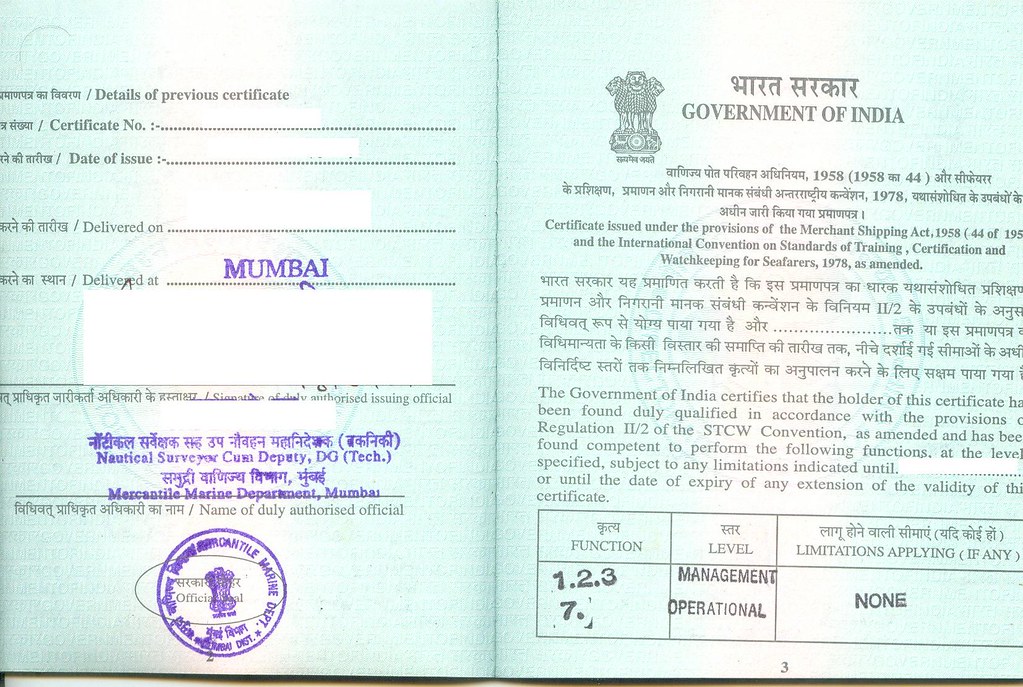
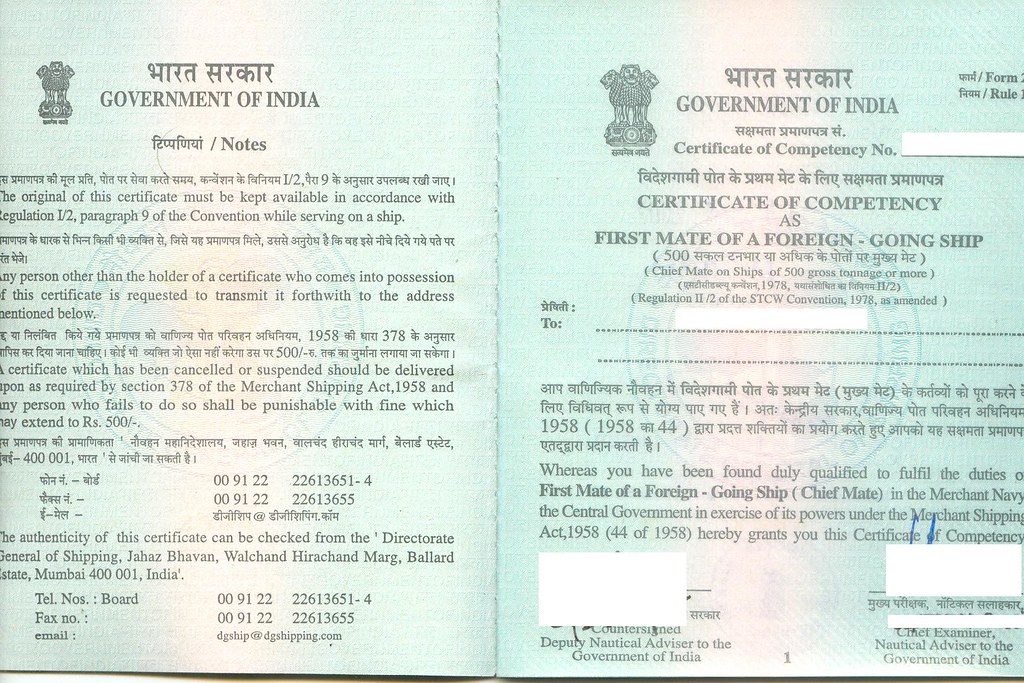
Shippies: job and profile
Why do people despise merchant navy job???
Oh, these ignorant land-lubbers.
I have suffered three matrimony rejections by far on the grounds that i am under-educated for the girl. Although i initially felt the setbacks but later i realised that it's coz those girls are too ignorant to understand what today's merchant naval officer's work profile is. Sometimes i even ponder if they would have had courage to speak those words if they knew what my school years profile/achievements were like. If not flabbergasting, i can safely assume myself to be an average or an above average student. and most girls in my co-ed were far below my level. In fact there were hardly 7 or 8 above me in a total strength of 60 students, of which 25 were girls. In my section composed on maths students only there were just 7 girls out of 41, 4 were better than I in terms of final marks sheet. but in overall performance including the extra-curricular, perhaps only 1 or 2 could stand out.
and the matrimonial rejections have been from even those who would be inferior to even the below average girl co-eds of my grade 12th.
But it's not these girls fault totally, as ignorance alleviation should have been our professional responsibility as also the reputation-building to shake off the image of "a wife at every port".
After 12th, year 1997, I was selected in an all-India exam conducted by our central govt PSU the Shipping Corporation Of India(the SCI) Ltd for training as deck cadet, officially called the Trainee Navigating Officer Cadet(TNOC). to me, the training was imparted at the SCI's own institute, Maritime training Institute(MTI), located just opposite the Powai lake, in Mumbai. I took my training from April 1998 to Aug 1998, and enrolled to batch 28-29, the first among many many "batches" i was to enrol with in years to come. Two batches 28 and 29 were conducted together, each consisting of 20 cadets, sorted in Alphabetical Order, hence the batch name 28-29. A parallel set of cadet, total 40 again, were sent to Training Ship Rehman(TS Rehmam), located in Raigarh and accessible from Nhava Sheva, and they too refer to themselves as "MTI 28-29, parallel Rehman".
Thus, total 80 of us were selected by the SCI for that batch, after a written , objective kind, exam of level slightly tougher than the NDA exams, and after one small interview. I wrote the exam on Dec 14th, 1997 in New Delhi and appeared in the interview on 11-12 Feb 1998 at "Shipping House" in Mumbai. (the head office of SCI is called Shipping House, located at Nariman Point just adjacent to the Mantralay(Legislative Assembly) of Maharashtra. In fact the Shipping House and the Express Tower(the Air India HQ) are the two more prominent buildings of this posh locality).SCI would induct some 180 cadets in one year.
After this, I joined my first ship for the on-board training on 22nd Nov 1998, a crude tanker called 'Maharshi Karve', which has been stationed in Mumbai High oil fields to store the crude oil that is dug from sea bed. Karve even till date remains the largest entity of this oil fields, among all its Platforms.
Anyways, just a week after my joining, this ship sailed away straight to Bahrain, for Dry docking. (every ship is bound to undergo repairs/overhauling every 2.5 yrs, in which she is taken off from water into a basin called Dry Dock, hence dry docking.)
I left Karve on 20th May 1998, after a 6 months haul, due to my grandfather's demise, and after that joined my second ship "State of Andhra Pradesh" on 11th of June 1998, from NSD 2( Netaji Subhash dock 2) in Kolkata.
Away from this, the more recognised gate to entry into merchant navy in those years was through TS Chanakya, for which the entrance till date is conducted through IIT-JEE. Actually, looking at the income that we people make by way of working with the foreign companies, the government was planning to put in some more high qualified youngsters into the field. Hence that was considered the core entry and mine was the side entry. the core entry would get a BSc nautical Science degree after a straight 3yrs training at TS Chanakya, located in Navi Mumbai, while we would simply get a Pre-sea Certificate after our 3months course. We were required to undergo 24months (actual time, not calendar time) on-board training to appear for the junior officer's exam, the rank being known as 3rd Mate. The 'degree cadets' would simply join ship directly as 'junior officer' for 1 yr, come back , take their BSc NS degree and join back ship as 3rd mate. But, later it was noted that the ship work required more of practical on-site training, not that the-classroom stuff. and hence by year 2000, the Govt changed its plan to make the 3-months pre-sea course an equally important gate to entry, as the 3-yr degree course. the deeper causes of this are as follows:--
The high-intellect IIT-qualified people from Chanakya were not much impressed with the profession, and even till date look for means to quit sea faring as early as possible. In the job scenario, the govt noted that sea-faring had become the fiefdom of Indian in past so many years, but due to soaring competition, under impact of globalisation, (opening of Chinese fronts to English Language, and the Philippines resurgence), the Indians had started to lose grounds in ship jobs. The growing economy of India was offering better and as much lucrative jobs on shore itself, like in software, engineering and management that IIT kind of people would naturally opt for. hence the only lot of people to stay back and work on ships were the 'pre-sea' kind of people. also, the degree cadets, joining as officers from day 1 of sea career had nil experience, and a few of them underwent some fatal accidents either on themselves or for the whole ship, that the govt was forced to re-consider their training procedure. In years to come, the govt modified it from, 3yrs course and degree straightaway to --> 3yrs course and six months on-board , giving the degree thereafter, --> 1 yr on-board --> 1 yr on-board + oral exam of 3rd mate. for us the course improved on as -- 3 months pre-sea + 24 months onboard , 3rd mate written and oral,--> 3months+24month onboard+ 3rdmate written and oral giving diploma in NS--> 1 yr pre sea+ 18 months on board + 3rd mate written and oral giving BSc Nautical Science from IGNOU.
The govt in its course of time had probably begun to realise that sea-farer, degree or pre-sea, whatever, in any case where not to "unqualified" stuff to be deprived of eligibilities for post like President and MP/MLAs considering the kind of people that flourish there. Also the growing hold of specialisation in all the technical fields was prompting everybody to accept the sea-farer's work also to be of equally high skills for a 'degree'.
All the oldies sitting in the govt were themselves ex-seafarers who didn't have a degree and they knew how stupid it was to imagine politicians of today are more eligible than themselves. The management skills required in the sea-faring job were rising to unparalleled limits, and there couldn't have been reasons to differ a "pre-sea' from a 'degree' guy when both were doing the same job. In fact the 'pre-sea' turned out to be better performer due to more practical lessons from early years. the 'degree' guy being from IIT and someone looking down at the profession was quite often a snooty guy.
in present, it is mandatory for anybody doing a deck cadet course coming from any training institute in India , to do a BSc NS course, by way of correspondence through IGNOU or by classroom course through TS Chanakya(which awards it's BSc degree under Univ of Mumbai).
but at the last, we guys had missed our bus for the degree course. but I personally had identified the importance of a degree in my school years itself, and so enrolled with IGNOU for a BCom course.
Taking the matrimonial rejection issue again, any land-lubber would not be aware of these developments in the shipping field, and continue to see it through of eyes of disparity. In reality, the govt, sort of realised its mistake of giving 'degree' as an Award to the IIT-guys alone, ( because education is every citizen's legal right and the "pre-sea" was also happening through govt defined procedure only, which meant there couldn't be any justification for depriving person of his legal right,) hence govt corrected itself by awarding 'degree' to all officers coming through any entrance channel. It also would aid the country's need for better skill manpower for handling even more advanced technology ships of future. even of now, I feel we are the fortunate few to get experiences of working amidst such high technology machinery, the ships and terminals, that any land-lubber cannot think of.
the shipping field in these many years of my service ,I have witness, has grown in leaps and bounce , in all the lines- the technical, the technological and the managerial. The SCI underwent the pressure of Disinvestment, and all in my seeing exploded out of its India-centric trade to take on the world in every corner it could. the ships began the carry cargos of fully not-India connection. the charters, the consignee, the receiver all from abroad. this until before was difficult as competitive behaviour of ours was lying inactive in the sack of social security. Oil giants of the world, the Shell, the Exxon, the Mobil, the British Petroleum, the Chevron , all had woken up to form one OCIMF(Oil Companies International Marine forum) and the ICS(Intern Chamber of Shipping) to set the highest of standards for ship's design, operation and management. for our desi PSU, adopting those standards till date is a predicament under all those national compulsions of welfare society, to be able to incur same revenue( cargo freight) from the charters that the best of the ships do. The International Maritime organisation, on the other hand has made things more stringent, enforcing more use of advanced technology, in order to attend to world's cry for zero-pollution marine environment. Sometimes I smile within myself that the procedures that I do on board , if they will ever be adopted by my country in its land for controlling the pollution. International regulation under IMO, the MARPOL, forces me to go to those limits to actually attain those standards, which our Air Act and Water pollution act don't call for even in theory.! the commercial operation exposes me to some understanding of the mercantile laws as practised among the traders at international level, the handling of ship's crew, attending to their medical needs, the provisions, the accommodation, the security aspect, bring to me the skills of Personnel management. the handling of cargo, navigation of ship, maintenance of ship and few of it's machinery are purely technical work requiring little bit of the operation management. In truth, as a chief mate, I feel myself to be what a District Magistrate would be to a town. Only thing that my domain is smaller- of length say 300 mtrs, human beings only 25, and property worth some 100million dollars(the petroleum oil) and the ship (worth some 80million dollars).
Wary girls also need to be assured of new-age mariners' faithfulness as life partners, an aspect which has been tremendously maligned with notions like "a wife at every port", and songs like " a little bit of monica in my life...". Actually the modern day sailors, who are coming from background like myself, are highly conscious of such maligned image and end up becoming more sober, good-habited guys than what other guys on land are. To aid us in this, our extremely busy schedule on ships(Particularly on management ranks like Captain/Chief Mate/Chief Engineer/1st Engineer), and very fast operations while the ship is in port, keeps us so tightly chained to our ships that shore leave is not availed in months of sailing tenure.
the other problem beams light over the issue of our nearness to our spouses in times of her need. In this regards, it is worthwhile to mention that one reason why India's mariners are losing the grips of Indians in sea-faring to the Philippines is primarily because they are going all out to settle on shore jobs as early as they could to join wives in setting and running their houses. the prospects of shore jobs are brightened up for Indians as of now. the chief engineers normally take up the technical management of ships from shore, while the Captains( Master Mariner, as they are professionally called) take up shore based personnel management and sometimes the commercial operations related to chartering and brokering of ships. the other lucrative jobs are like - joining as trainer/teaching faculty; as surveyors for the insurance "Clubs"( as they are known as, in our parlance); joining as Govt Authorities for Surveying and examining of ships for sea-worthiness and selection/examination of officers/manning staff; joining as Surveyors with the Standardisation organisation like the Indian register of Shipping, and many more; joining the port authorities; joining as 'Pilots' (professional navigators who haul the ship in/out of the ports).
being a management professional with an excellent work-experience in the field of logistics, many people have also chosen to formally do up an MBA and switch to other logictics, Supply-chain, charter/brokering firms and so on. Additionally, to the shore job in the shipping company, they keep their doors open to us for all ranks including that of the Chairman-cum-MD. In SCI itself, there has already been on Captain Radhakrishnan, who served the company from rank of cadet to CMD, until retirement.Foreign companies also offer job in their branch offices at equivalent portfolios.
Most of us switch over to these streams by the age of 35. Only issue that hangs is that though these all are also high-income jobs, but not so in comparison with our on-board salaries. Sometimes people choose to continue sailing life long as sea-life is more hassle-free than shore jobs, and more yielding too.
If only, the common land people knew that !
Oh, these ignorant land-lubbers.
I have suffered three matrimony rejections by far on the grounds that i am under-educated for the girl. Although i initially felt the setbacks but later i realised that it's coz those girls are too ignorant to understand what today's merchant naval officer's work profile is. Sometimes i even ponder if they would have had courage to speak those words if they knew what my school years profile/achievements were like. If not flabbergasting, i can safely assume myself to be an average or an above average student. and most girls in my co-ed were far below my level. In fact there were hardly 7 or 8 above me in a total strength of 60 students, of which 25 were girls. In my section composed on maths students only there were just 7 girls out of 41, 4 were better than I in terms of final marks sheet. but in overall performance including the extra-curricular, perhaps only 1 or 2 could stand out.
and the matrimonial rejections have been from even those who would be inferior to even the below average girl co-eds of my grade 12th.
But it's not these girls fault totally, as ignorance alleviation should have been our professional responsibility as also the reputation-building to shake off the image of "a wife at every port".
After 12th, year 1997, I was selected in an all-India exam conducted by our central govt PSU the Shipping Corporation Of India(the SCI) Ltd for training as deck cadet, officially called the Trainee Navigating Officer Cadet(TNOC). to me, the training was imparted at the SCI's own institute, Maritime training Institute(MTI), located just opposite the Powai lake, in Mumbai. I took my training from April 1998 to Aug 1998, and enrolled to batch 28-29, the first among many many "batches" i was to enrol with in years to come. Two batches 28 and 29 were conducted together, each consisting of 20 cadets, sorted in Alphabetical Order, hence the batch name 28-29. A parallel set of cadet, total 40 again, were sent to Training Ship Rehman(TS Rehmam), located in Raigarh and accessible from Nhava Sheva, and they too refer to themselves as "MTI 28-29, parallel Rehman".
Thus, total 80 of us were selected by the SCI for that batch, after a written , objective kind, exam of level slightly tougher than the NDA exams, and after one small interview. I wrote the exam on Dec 14th, 1997 in New Delhi and appeared in the interview on 11-12 Feb 1998 at "Shipping House" in Mumbai. (the head office of SCI is called Shipping House, located at Nariman Point just adjacent to the Mantralay(Legislative Assembly) of Maharashtra. In fact the Shipping House and the Express Tower(the Air India HQ) are the two more prominent buildings of this posh locality).SCI would induct some 180 cadets in one year.
After this, I joined my first ship for the on-board training on 22nd Nov 1998, a crude tanker called 'Maharshi Karve', which has been stationed in Mumbai High oil fields to store the crude oil that is dug from sea bed. Karve even till date remains the largest entity of this oil fields, among all its Platforms.
Anyways, just a week after my joining, this ship sailed away straight to Bahrain, for Dry docking. (every ship is bound to undergo repairs/overhauling every 2.5 yrs, in which she is taken off from water into a basin called Dry Dock, hence dry docking.)
I left Karve on 20th May 1998, after a 6 months haul, due to my grandfather's demise, and after that joined my second ship "State of Andhra Pradesh" on 11th of June 1998, from NSD 2( Netaji Subhash dock 2) in Kolkata.
Away from this, the more recognised gate to entry into merchant navy in those years was through TS Chanakya, for which the entrance till date is conducted through IIT-JEE. Actually, looking at the income that we people make by way of working with the foreign companies, the government was planning to put in some more high qualified youngsters into the field. Hence that was considered the core entry and mine was the side entry. the core entry would get a BSc nautical Science degree after a straight 3yrs training at TS Chanakya, located in Navi Mumbai, while we would simply get a Pre-sea Certificate after our 3months course. We were required to undergo 24months (actual time, not calendar time) on-board training to appear for the junior officer's exam, the rank being known as 3rd Mate. The 'degree cadets' would simply join ship directly as 'junior officer' for 1 yr, come back , take their BSc NS degree and join back ship as 3rd mate. But, later it was noted that the ship work required more of practical on-site training, not that the-classroom stuff. and hence by year 2000, the Govt changed its plan to make the 3-months pre-sea course an equally important gate to entry, as the 3-yr degree course. the deeper causes of this are as follows:--
The high-intellect IIT-qualified people from Chanakya were not much impressed with the profession, and even till date look for means to quit sea faring as early as possible. In the job scenario, the govt noted that sea-faring had become the fiefdom of Indian in past so many years, but due to soaring competition, under impact of globalisation, (opening of Chinese fronts to English Language, and the Philippines resurgence), the Indians had started to lose grounds in ship jobs. The growing economy of India was offering better and as much lucrative jobs on shore itself, like in software, engineering and management that IIT kind of people would naturally opt for. hence the only lot of people to stay back and work on ships were the 'pre-sea' kind of people. also, the degree cadets, joining as officers from day 1 of sea career had nil experience, and a few of them underwent some fatal accidents either on themselves or for the whole ship, that the govt was forced to re-consider their training procedure. In years to come, the govt modified it from, 3yrs course and degree straightaway to --> 3yrs course and six months on-board , giving the degree thereafter, --> 1 yr on-board --> 1 yr on-board + oral exam of 3rd mate. for us the course improved on as -- 3 months pre-sea + 24 months onboard , 3rd mate written and oral,--> 3months+24month onboard+ 3rdmate written and oral giving diploma in NS--> 1 yr pre sea+ 18 months on board + 3rd mate written and oral giving BSc Nautical Science from IGNOU.
The govt in its course of time had probably begun to realise that sea-farer, degree or pre-sea, whatever, in any case where not to "unqualified" stuff to be deprived of eligibilities for post like President and MP/MLAs considering the kind of people that flourish there. Also the growing hold of specialisation in all the technical fields was prompting everybody to accept the sea-farer's work also to be of equally high skills for a 'degree'.
All the oldies sitting in the govt were themselves ex-seafarers who didn't have a degree and they knew how stupid it was to imagine politicians of today are more eligible than themselves. The management skills required in the sea-faring job were rising to unparalleled limits, and there couldn't have been reasons to differ a "pre-sea' from a 'degree' guy when both were doing the same job. In fact the 'pre-sea' turned out to be better performer due to more practical lessons from early years. the 'degree' guy being from IIT and someone looking down at the profession was quite often a snooty guy.
in present, it is mandatory for anybody doing a deck cadet course coming from any training institute in India , to do a BSc NS course, by way of correspondence through IGNOU or by classroom course through TS Chanakya(which awards it's BSc degree under Univ of Mumbai).
but at the last, we guys had missed our bus for the degree course. but I personally had identified the importance of a degree in my school years itself, and so enrolled with IGNOU for a BCom course.
Taking the matrimonial rejection issue again, any land-lubber would not be aware of these developments in the shipping field, and continue to see it through of eyes of disparity. In reality, the govt, sort of realised its mistake of giving 'degree' as an Award to the IIT-guys alone, ( because education is every citizen's legal right and the "pre-sea" was also happening through govt defined procedure only, which meant there couldn't be any justification for depriving person of his legal right,) hence govt corrected itself by awarding 'degree' to all officers coming through any entrance channel. It also would aid the country's need for better skill manpower for handling even more advanced technology ships of future. even of now, I feel we are the fortunate few to get experiences of working amidst such high technology machinery, the ships and terminals, that any land-lubber cannot think of.
the shipping field in these many years of my service ,I have witness, has grown in leaps and bounce , in all the lines- the technical, the technological and the managerial. The SCI underwent the pressure of Disinvestment, and all in my seeing exploded out of its India-centric trade to take on the world in every corner it could. the ships began the carry cargos of fully not-India connection. the charters, the consignee, the receiver all from abroad. this until before was difficult as competitive behaviour of ours was lying inactive in the sack of social security. Oil giants of the world, the Shell, the Exxon, the Mobil, the British Petroleum, the Chevron , all had woken up to form one OCIMF(Oil Companies International Marine forum) and the ICS(Intern Chamber of Shipping) to set the highest of standards for ship's design, operation and management. for our desi PSU, adopting those standards till date is a predicament under all those national compulsions of welfare society, to be able to incur same revenue( cargo freight) from the charters that the best of the ships do. The International Maritime organisation, on the other hand has made things more stringent, enforcing more use of advanced technology, in order to attend to world's cry for zero-pollution marine environment. Sometimes I smile within myself that the procedures that I do on board , if they will ever be adopted by my country in its land for controlling the pollution. International regulation under IMO, the MARPOL, forces me to go to those limits to actually attain those standards, which our Air Act and Water pollution act don't call for even in theory.! the commercial operation exposes me to some understanding of the mercantile laws as practised among the traders at international level, the handling of ship's crew, attending to their medical needs, the provisions, the accommodation, the security aspect, bring to me the skills of Personnel management. the handling of cargo, navigation of ship, maintenance of ship and few of it's machinery are purely technical work requiring little bit of the operation management. In truth, as a chief mate, I feel myself to be what a District Magistrate would be to a town. Only thing that my domain is smaller- of length say 300 mtrs, human beings only 25, and property worth some 100million dollars(the petroleum oil) and the ship (worth some 80million dollars).
Wary girls also need to be assured of new-age mariners' faithfulness as life partners, an aspect which has been tremendously maligned with notions like "a wife at every port", and songs like " a little bit of monica in my life...". Actually the modern day sailors, who are coming from background like myself, are highly conscious of such maligned image and end up becoming more sober, good-habited guys than what other guys on land are. To aid us in this, our extremely busy schedule on ships(Particularly on management ranks like Captain/Chief Mate/Chief Engineer/1st Engineer), and very fast operations while the ship is in port, keeps us so tightly chained to our ships that shore leave is not availed in months of sailing tenure.
the other problem beams light over the issue of our nearness to our spouses in times of her need. In this regards, it is worthwhile to mention that one reason why India's mariners are losing the grips of Indians in sea-faring to the Philippines is primarily because they are going all out to settle on shore jobs as early as they could to join wives in setting and running their houses. the prospects of shore jobs are brightened up for Indians as of now. the chief engineers normally take up the technical management of ships from shore, while the Captains( Master Mariner, as they are professionally called) take up shore based personnel management and sometimes the commercial operations related to chartering and brokering of ships. the other lucrative jobs are like - joining as trainer/teaching faculty; as surveyors for the insurance "Clubs"( as they are known as, in our parlance); joining as Govt Authorities for Surveying and examining of ships for sea-worthiness and selection/examination of officers/manning staff; joining as Surveyors with the Standardisation organisation like the Indian register of Shipping, and many more; joining the port authorities; joining as 'Pilots' (professional navigators who haul the ship in/out of the ports).
being a management professional with an excellent work-experience in the field of logistics, many people have also chosen to formally do up an MBA and switch to other logictics, Supply-chain, charter/brokering firms and so on. Additionally, to the shore job in the shipping company, they keep their doors open to us for all ranks including that of the Chairman-cum-MD. In SCI itself, there has already been on Captain Radhakrishnan, who served the company from rank of cadet to CMD, until retirement.Foreign companies also offer job in their branch offices at equivalent portfolios.
Most of us switch over to these streams by the age of 35. Only issue that hangs is that though these all are also high-income jobs, but not so in comparison with our on-board salaries. Sometimes people choose to continue sailing life long as sea-life is more hassle-free than shore jobs, and more yielding too.
If only, the common land people knew that !
Monday, June 23, 2008
22.06.08
I always feel disgusted at hearing that there is so much widespread corruption and malpractices everywhere, or say in any given field. Such talks when done in is privacy, and in certain abhorrent style, give me a feeling of **surrendering to situation**. they subvert my will to fight. they deter , they discourage the feeling of truth fullness and honesty within. They are the admission and justification of self being corrupt, by the speaker. they are a cultural propagation and continuing of corruption and ill-actions once they have happened anywhere in our society. they have no desire to bring change, to rectify and to improve. there is no remorse and apology.they make dishonesty even more blatant.
21.06.2008
What could be wrong in my behavior?? i am quite serious and stressed at the time I am on ships. when the orders are given i am unable to take them with a receptive heart.The senior on the other hand is himself a serious person mostly. Then the two serious thoughts collide trying to surmount each other.like when he ask me to do tank cleaning seriously as a matter of need, i begin to seriously think of the period of rest. When the cargo is halted due to generator troubles, i am told that i should rush to attend coz the cargo is my duty, but i begin to seriously think if i have to be there necessarily all the time.
seriousness arouses ego. hinders dissolving of frustration and anger in work. We have to learn to be cheerful.it's just that being cheerful is not easy job while on board. People have their own ways to enjoy. Most shippies, like the one on "Challenge Plus" used alcohol, cigs, movies for de-stressing. My way is by communicating the social and political thoughts coz somehow i feel too connected with them.then the seniors use their learning to push you into their kind of working while u are, and even admitting, of being unaware of methods in your jobs.They tend to take advantage of your ignorance.Private get-togethers also get consumed in surmounting each other.there are less narratives to explain the situation or the job requisites. on the explanation thought, it brings me to say that, like i have always been saying, most of us people are too poor in story-telling, it's as though story-telling is a bad deed. and that's where we lack. we dont have much skill to explain and convince people. we often go on to ask Arjuna to shoot at Bhism explaining that it's coz he is old, unworthy, insane, aged, etc..the other demeaning thoughts. The skills of Krishna , of how he expounded on the Karma, to convince Arjune to shoot at Bhism is too high up in sky for us to practice. How many of us read literature so deeply to be able to *communicate* even the sinful sounding thoughts to people around.People got to learn that skill.
I always feel disgusted at hearing that there is so much widespread corruption and malpractices everywhere, or say in any given field. Such talks when done in is privacy, and in certain abhorrent style, give me a feeling of **surrendering to situation**. they subvert my will to fight. they deter , they discourage the feeling of truth fullness and honesty within. They are the admission and justification of self being corrupt, by the speaker. they are a cultural propagation and continuing of corruption and ill-actions once they have happened anywhere in our society. they have no desire to bring change, to rectify and to improve. there is no remorse and apology.they make dishonesty even more blatant.
21.06.2008
What could be wrong in my behavior?? i am quite serious and stressed at the time I am on ships. when the orders are given i am unable to take them with a receptive heart.The senior on the other hand is himself a serious person mostly. Then the two serious thoughts collide trying to surmount each other.like when he ask me to do tank cleaning seriously as a matter of need, i begin to seriously think of the period of rest. When the cargo is halted due to generator troubles, i am told that i should rush to attend coz the cargo is my duty, but i begin to seriously think if i have to be there necessarily all the time.
seriousness arouses ego. hinders dissolving of frustration and anger in work. We have to learn to be cheerful.it's just that being cheerful is not easy job while on board. People have their own ways to enjoy. Most shippies, like the one on "Challenge Plus" used alcohol, cigs, movies for de-stressing. My way is by communicating the social and political thoughts coz somehow i feel too connected with them.then the seniors use their learning to push you into their kind of working while u are, and even admitting, of being unaware of methods in your jobs.They tend to take advantage of your ignorance.Private get-togethers also get consumed in surmounting each other.there are less narratives to explain the situation or the job requisites. on the explanation thought, it brings me to say that, like i have always been saying, most of us people are too poor in story-telling, it's as though story-telling is a bad deed. and that's where we lack. we dont have much skill to explain and convince people. we often go on to ask Arjuna to shoot at Bhism explaining that it's coz he is old, unworthy, insane, aged, etc..the other demeaning thoughts. The skills of Krishna , of how he expounded on the Karma, to convince Arjune to shoot at Bhism is too high up in sky for us to practice. How many of us read literature so deeply to be able to *communicate* even the sinful sounding thoughts to people around.People got to learn that skill.
Subscribe to:
Posts (Atom)